
TL;DR
- CMIR certification is the only professional credential dedicated exclusively to investment recovery, awarded by the Investment Recovery Association since 1996.
- Earning your CMIR requires 3+ years of experience, a completed Personal Data Form with 35 points, an ethics pledge, and passing a comprehensive written exam.
- Certified professionals consistently earn 15-30% higher salaries than non-certified peers, and 63% of certified professionals report receiving a promotion.
- With circular economy employment growing at 25.65% CAGR through 2031, demand for credentialed investment recovery professionals is accelerating.
- The CMIR exam covers six domains: surplus asset valuation, warehousing, sales, contracts and negotiations, recycling, and scrap management.
What Is CMIR Certification and Why Does It Matter in 2026?
CMIR certification stands for Certified Manager of Investment Recovery, and it is the gold standard credential for professionals who manage surplus assets, drive sustainable reuse, and recover value from end-of-life materials. Offered exclusively by the Investment Recovery Association (IRA), the CMIR certification has recognized more than 250 professionals across North America since its inception in 1996. In an era where circular economy jobs are expanding rapidly and organizations face mounting pressure to demonstrate sustainability credentials, earning your CMIR certification has never been more strategically valuable.
The investment recovery profession sits at the intersection of financial performance and environmental stewardship. As corporate sustainability mandates intensify and 2026 investment recovery trends reshape how organizations handle surplus assets, the CMIR designation signals that a professional has demonstrated the knowledge, experience, and ethical commitment necessary to lead in this specialized field. According to a 2025 IFC report on circular economy employment, between 121 and 142 million people worldwide now work in circular economy roles, and that number is accelerating.
Certified Managers of Investment Recovery recognized since 1996
Who Should Pursue CMIR Certification?
CMIR certification is designed for professionals who work directly with surplus materials, idle equipment, and end-of-life assets. But its value extends well beyond traditional investment recovery roles. If your work involves maximizing returns on underutilized assets while minimizing environmental impact, the CMIR credential can elevate your career trajectory.
Investment Recovery Professionals
The core audience for CMIR certification includes investment recovery professionals who manage asset disposition programs at utilities, manufacturers, and large enterprises. These professionals are responsible for identifying surplus, determining optimal disposition channels, and tracking financial and environmental outcomes. The CMIR validates their expertise and positions them as sustainability leaders within their organizations.
Supply Chain and Asset Management Professionals
Professionals pursuing a supply chain professional certification or an asset management certification will find that the CMIR complements broader credentials like the CSCP (Certified Supply Chain Professional). While CSCP covers the full supply chain lifecycle, the CMIR dives deep into what happens at the end of that lifecycle, covering surplus asset valuation, scrap management, and environmentally responsible disposition. For those working in IT asset management certification pathways, the CMIR adds a strategic layer focused on maximizing financial recovery alongside data security and compliance.
Key Distinction: Unlike general asset management certification programs, the CMIR is the only investment recovery certification that specifically validates expertise in surplus asset valuation, industrial recycling, and sustainable asset disposition. It is the credential that proves you understand the full end-of-life asset lifecycle.
CMIR Certification Requirements and Eligibility
Earning the CMIR requires a combination of professional experience, documented qualifications, ethical commitment, and demonstrated knowledge. Here is what you need to qualify:
Experience: A minimum of three years working in the investment recovery profession. This includes roles in surplus asset management, equipment remarketing, scrap and recycling operations, and corporate asset disposition.
Character and Reputation: Applicants must be acceptable in character, ability, and professional reputation within the industry.
Ethics Pledge: You must pledge in writing to adhere to the IRA Code of Ethics, which governs professional conduct in investment recovery transactions.
Personal Data Form: This is the centerpiece of the CMIR application. You must accumulate 35 points across categories that reflect your professional depth and industry contributions.
The Personal Data Form: Building Your 35 Points
The Personal Data Form evaluates your qualifications across multiple dimensions. Points are awarded for professional experience in investment recovery, formal education and relevant training, active participation in IRA events and committees, published articles or presentations on IR topics, and leadership roles within the profession. Your completed form must be postmarked no later than 45 days before the opening day of the IRA Conference where you plan to sit for the exam. Planning ahead is critical because this timeline gives the certification committee adequate time to review your qualifications.
CMIR Certification Exam Preparation: What to Study
The CMIR exam tests a working knowledge of the investment recovery profession across six core domains. Subject matter experts designed the exam to ensure that certified asset recovery professionals demonstrate competence in every critical area of the discipline.
Surplus Asset Valuation
Understanding how to accurately value surplus assets is fundamental to investment recovery. The exam covers surplus asset management principles, including market-based valuation approaches, depreciation factors, condition assessment frameworks, and the economic drivers that affect resale and scrap value. Knowing when to remarket, refurbish, or recycle an asset is a core competency the CMIR exam evaluates.
Contracts, Negotiations, and Sales
Investment recovery professionals must be skilled negotiators who can structure contracts that protect their organization while maximizing financial returns. The exam covers contract types, liability management, terms and conditions best practices, auction strategies, and third-party broker agreements. Understanding how to navigate ROI optimization in asset management through effective negotiation is essential.
Recycling and Scrap Management
This domain covers the environmental and operational dimensions of material recovery. Expect questions on recycling processes, scrap metal markets and pricing dynamics, hazardous material handling requirements, regulatory compliance, and e-waste disposition. As sustainability credentials become increasingly important for organizational ESG reporting, this domain is particularly relevant to the modern investment recovery professional.
| Exam Domain | Key Topics | Study Focus |
|---|---|---|
| Surplus Asset Valuation | Market analysis, depreciation, condition grading | Valuation methods and pricing strategies |
| Warehousing | Inventory management, storage optimization, tracking | Asset tracking and warehouse operations |
| Sales | Channels, auctions, direct sales, remarketing | Disposition channel selection and optimization |
| Contracts and Negotiations | Contract law, liability, terms, broker agreements | Legal frameworks and negotiation tactics |
| Recycling | Material recovery, processes, environmental compliance | Recycling best practices and regulations |
| Scrap | Metal markets, pricing, hazardous materials, e-waste | Market dynamics and compliance requirements |
Career Benefits of CMIR Certification
Investing in a professional certification supply chain or asset management credential delivers measurable returns. Research shows that certified professionals consistently earn 15-30% higher salaries than their non-certified peers, and according to the Pearson VUE 2025 Value of Certification Report, 63% of professionals received or expected a promotion after earning their credential. While these statistics span all professional certifications, the principles apply directly to the investment recovery field. Employers increasingly look for proven credentials when filling leadership positions, and the CMIR provides exactly that validation.
For investment recovery professionals specifically, the CMIR delivers career advantages that go beyond salary. Savvy employers understand that a certified professional is their best investment for staying ahead of circular economy opportunities and compliance challenges. The CMIR designation proves that you have achieved the highest level of professional standards, knowledge, and expertise in investment recovery.
Sustainability Edge: With North America’s circular economy market expected to grow at a 25.65% compound annual growth rate through 2031 and 125,000 new circular economy jobs added globally in the past year alone, CMIR-certified professionals are positioned at the front of a rapidly expanding field. The certification directly validates your ability to drive both financial returns and environmental impact.
The career benefits of CMIR certification include enhanced credibility with employers and stakeholders who recognize the IRA as the leading authority in investment recovery, a competitive edge when pursuing promotions or new roles in an increasingly crowded sustainability job market, access to the IRA’s professional network of certified peers and industry leaders, demonstrated commitment to ethical practices and continuing professional development, and stronger positioning to lead sustainable asset management initiatives within your organization.
CMIR Certification vs. Other Professional Certifications
Professionals evaluating their certification options often compare the CMIR to other asset management certification and supply chain credentials. Here is how they stack up:
| Certification | Focus Area | Best For | Unique Value |
|---|---|---|---|
| CMIR | Investment recovery and surplus asset disposition | IR professionals, asset managers | Only credential focused on end-of-life asset value recovery |
| CSCP | End-to-end supply chain management | Supply chain managers | Broad supply chain coverage from sourcing to delivery |
| IAM Certificate | Infrastructure asset management | Infrastructure and facilities managers | ISO 55000 aligned asset lifecycle management |
| IAITAM (ITAM) | IT asset management and disposition | IT asset managers | IT-specific asset lifecycle and ITAD compliance |
| R2 Certification | Electronics recycling standards | ITAD service providers | Facility-level certification for responsible recycling |
The CMIR stands alone as the only professional certification supply chain credential that specifically addresses investment recovery. Many professionals find that pairing the CMIR with a complementary certification like the CSCP or an it asset management certification creates a powerful combination that covers both the forward and reverse supply chain.
How to Maintain Your CMIR Certification
Earning the CMIR is not a one-time achievement. Maintaining your credential requires ongoing engagement with the profession through continuing education, IRA membership, and active participation in industry events. The IRA offers webinars, workshops, and the annual Conference and Trade Show as pathways for continuing professional development. This commitment to lifelong learning mirrors best practices across other professional certification programs and ensures that CMIR holders stay current with evolving market conditions, regulatory changes, and emerging technologies like AI-driven asset management tools.
For seasoned professionals, the IRA also awards the CMIR Fellow designation. This higher recognition is granted to individuals who have been active IRA members with a minimum of 20 years of life experience in investment recovery. The CMIR Fellow represents the pinnacle of professional achievement in the field and is reserved for those who have made lasting contributions to the profession.
The Growing Demand for Credentialed Investment Recovery Professionals
The business case for credentialed professionals in the investment recovery space has never been stronger. Organizations across industries are recognizing that proper management of end-of-life assets is not just an operational necessity but a strategic advantage. Research shows that investment recovery returns $20 or more for every $1 invested, making it one of the highest-ROI functions in corporate operations.
As ESG (Environmental, Social, and Governance) reporting becomes standard practice for publicly traded companies, the ability to quantify and demonstrate sustainable asset disposition becomes a boardroom priority. Professionals who hold recognized credentials are better positioned to lead these initiatives and communicate their impact to senior leadership. The circular economy is no longer a fringe concept but a mainstream business strategy, and credentialed leaders are essential to executing it effectively.
Industries with the highest demand for qualified investment recovery talent include utilities and energy companies managing large capital equipment fleets, manufacturing enterprises with complex material streams, technology companies navigating rapid hardware refresh cycles, healthcare organizations handling regulated medical equipment, and government agencies managing public surplus. Each of these sectors values professionals who can demonstrate verified expertise through recognized industry credentials.
Getting Started: Your CMIR Certification Roadmap
Ready to pursue your CMIR certification? Here is a step-by-step roadmap to guide your journey:
Step 1: Assess Your Eligibility. Confirm that you have at least three years of professional experience in investment recovery or a closely related field. If you are new to the profession, focus on building your experience while engaging with IRA resources and industry best practices.
Step 2: Join the Investment Recovery Association. Membership provides access to educational resources, networking opportunities, and the certification program. Visit invrecovery.org to learn about membership options.
Step 3: Complete Your Personal Data Form. Document your experience, education, and industry contributions to reach the 35-point threshold. Start early because building your points may take time if you need additional professional development credits.
Step 4: Submit Your Application. Submit your Personal Data Form at least 45 days before the IRA Conference where you plan to take the exam.
Step 5: Prepare for the Exam. Study the six exam domains systematically. Leverage IRA webinars, the IRA knowledge base, and peer study groups. Focus on areas where you have less hands-on experience.
Step 6: Take the Exam. The certification exams are administered at the annual IRA Conference and Trade Show, with occasional testing at other locations throughout the year. Arrive well-rested and confident in your preparation across all six domains.
Step 7: Maintain and Grow. After certification, stay engaged through continuing education and consider working toward the CMIR Fellow designation as you advance in your career.
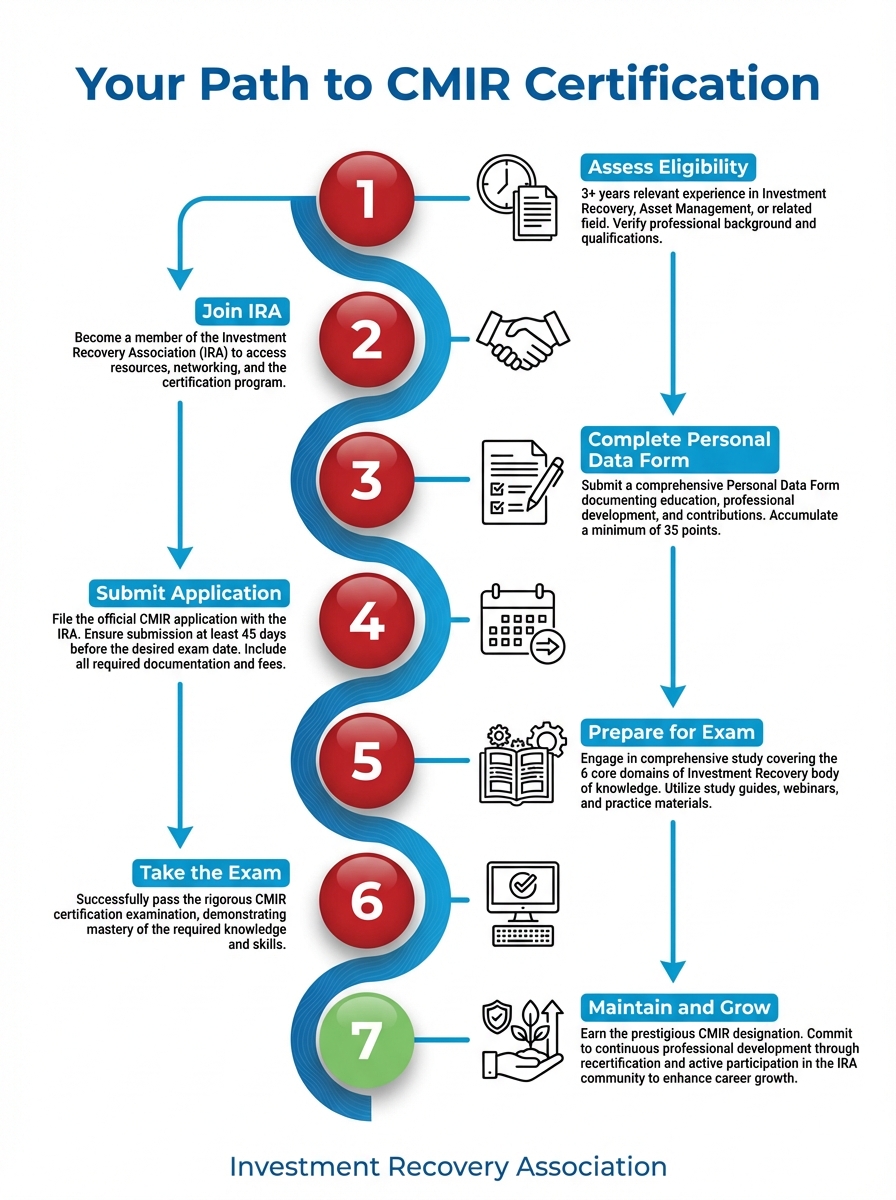
Your step-by-step roadmap to earning CMIR certification in 2026.