TL;DR
- AI in reverse logistics has moved from novelty to necessity. Trey Collson, CEO of Amplio, showed how AI agents now help IR teams evaluate surplus, appraise assets and decide faster.
- AI agents (“500 very smart kids”) appraised 10,000 spare parts in seven minutes for $24, producing value ranges, confidence scores and recommended sales channels.
- Agents still lack street smarts: after IR pros filtered out counterfeit and refurbished units, a discontinued item went from 38 listings valued at $95 to $115 to 14 verified listings with a $320 median price.
- IR professionals still own sold vs. asking prices, provenance, buyer relationships, market absorption and timing. The future is AI powered IR, not AI vs. IR.
Trey Collson explains how AI agents can accelerate asset recovery, with human experience providing the market knowledge, oversight, and judgment that matter.
Based on a presentation by Trey Collson, CEO of Amplio.
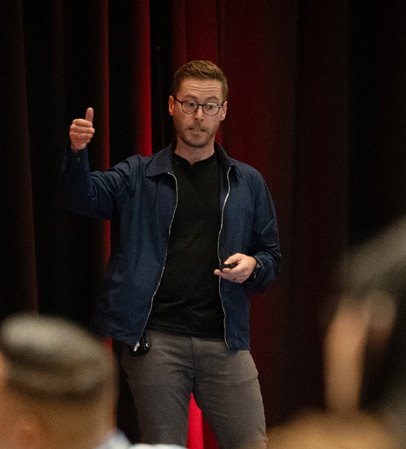
Trey Collson, CEO of Amplio.
In the cover story, Kris Waters shared her strategy for successful storytelling to elevate IR’s strategic importance to an organization. And that story depends on auditable and documented data for credibility and eventual buy-in. And in today’s lightning-quick business world, access to that data needs to be virtually instantaneous.
That’s the perfect introduction to why and how AI is elevating IR in organizations everywhere, all the way up to the boardroom.
Crystal clear message
In reverse logistics, AI is moving us from novelty to necessity in just a few years, and at whiplash speed. Trey Collson is CEO of Amplio, a solutions provider for industrial surplus. He presented, “From Idle Asset to Value: How AI is Transforming the Reverse Logistics Journey,” offering a practitioner-level look at how AI is reshaping the way organizations evaluate surplus, appraise assets and make faster, more confident decisions. His message was crystal clear: AI is not here to replace IR professionals; it’s here to make their work more strategic, more human and more valuable. Oh…and one more thing; the 2026 AI ‘kids’ are smarter and better than before.
500 “smart kids”: from narrow to general intelligence
Collson started with a fun, yet mind-blowing example. His team was asked to evaluate 10,000 spare parts, a task that would normally take weeks or even months. He used AI agents or jokingly referred to as hiring “500 very smart kids” to appraise the list. Shockingly enough, it only took seven minutes… and only cost $24.
to appraise 10,000 spare parts with AI agents
This is the new reality; tasks once requiring large teams, long timelines and significant budget can now be completed in minutes with high accuracy.
He noted that in his prior role back in 2017, they built a single model to predict inconsistent ocean-freight ETAs requiring huge amounts of capital, time, development and expertise.
Today, off-the-shelf AI models can perform millions of tasks, require no custom training, and cost less than a junior employee’s monthly salary.
This change from customized, single-purpose models to general-purpose intelligence has unlocked new efficiency opportunities for IR teams.
2026: When the “kids” got smarter
Earlier AI agents could perform tasks but often stalled or gave questionable quality. As Collson stated, they would recognize that they needed a lunch break… and gave up halfway. In 2026, we welcomed the new breed of smarter kids on the block.
In 2026, agents can now:
- Work collaboratively
- Split large workloads
- Review each other’s outputs
- Converge on a single, validated answer
So, this level of teamwork allows IR professionals to deploy hundreds of agents simultaneously, each performing a narrow, high-quality task.
Let’s go back to that 10,000-SKU example with the “smarter kids”
- Split the list
- Appraised each item
- Reviewed each other’s work
- Produced a unified valuation with value ranges, confidence scores, and recommended sales channels
He stated that this was not just automation; it’s scalable expertise.
But so far, we’ve focused on spare parts and SKUs, what about equipment? He stated that it works the same way but requires slightly more knowledge to shape the output correctly. This is where human oversight and context are even more important.
Can the smartest kid appraise your equipment?
Good question. AI is powerful, but IR expertise is irreplaceable and Collson cited a great example why. Agents were tasked to evaluate a discontinued item. AI output found 38 listings with an initial suggested retail value between $95 and $115. But IR professionals knew that the market was flooded with counterfeit and refurbished units.
After adding new filters that excluded used/refurbished units and sellers without a verified track record, the agents redid their assignment with:
- 14 verified listings
- All new, original packaging
- Median price: $320
So the smartest kid in the room lacks ‘street smarts’ and that only comes with well-earned, human experience.
IR market oversight can’t be overstated
He believes that the best companies utilizing AI don’t view it as a way to replace people, but to empower them to do more in their roles.
IR teams hold remarketing knowledge that models cannot infer:
- Sold prices vs. asking prices: People can ask for any amount of money in the secondary market… it doesn’t mean that’s the liquidity point. It also doesn’t mean that any inventory has ever been sold at that price.
- Condition and provenance: Counterfeit risk, refurbishment quality and chain of custody history are human-documented essentials.
- Who is buying right now: You have amazing relationships with your customers. You know who is buying, who is selling and when. That comes from human interaction and relationship building.
- Market absorption rates: Flooding the market with surplus inventory can decrease prices. AI cannot predict this. That’s information only you can analyze.
- Timing and strategy: Only IR teams can do tasks like release schedules and channel selection that still require input.
AI allows professionals to focus on negotiation, strategy, relationship building and risk management instead of time-consuming repetitive tasks.
He cautioned against treating AI agents like unsupervised interns. You’re not going to just hand them over the keys and head off to the golf course. AI requires onboarding, guardrails, and oversight, just like junior staff.
Why AI cannot replace IR professionals
ASSET 2.0 dug deeper (thanks to Microsoft CoPilot) on the unique value that only expert oversight and human interaction can provide.
- AI cannot walk a facility or inspect assets in person: IR requires human senses, to judge equipment condition. AI can analyze photos, but it cannot detect subtle wear, vibration, heat or safety risks the way a trained professional can.
- AI cannot negotiate or build trust with buyers and vendors: IR is a relationship business. AI cannot read tone, sense hesitation, build rapport or push back when someone lowballs a price. Human negotiation skills directly increase recovery value.
- AI cannot read the ‘vibe’ of company politics or internal dynamics: IR professionals navigate personalities, turf battles, budget timing and “who really owns this asset.”
- AI cannot make judgment calls in gray areas: IR often deals with incomplete data, borderline safety issues and ambiguous regulations.
- AI cannot handle unique assets: IR frequently deals with prototypes, custom equipment, obsolete machinery, and mixed lots. AI works best with patterns; IR deals with exceptions.
- AI cannot manage on site logistics or physical operations: Loading, rigging, palletizing, verifying PPE, checking for leaks, supervising contractors: these require human presence.
- AI cannot verify ethical or compliant disposal in the real world: AI can flag risks, but it cannot walk a recycler’s facility, inspect processes or confirm proper data destruction. Human scrutiny is essential for environmental safety and regulatory compliance.
- AI cannot handle emotionally sensitive situations: IR professionals often work during layoffs, plant closures, emergencies or high stress transitions. AI cannot provide empathy, reassurance or human support during difficult moments.
- AI cannot advocate for IR or persuade leadership: AI can generate reports, but it cannot explain subtleties, defend decisions or build credibility with executives. IR leaders elevate the function through communication, confidence and expertise.
- AI cannot replace human intuition, experience and creativity: IR is full of surprises: odd assets, last minute changes and unexpected opportunities. Human intuition often finds value where data never would. AI can assist, but it cannot innovate the way experienced IR professionals do.
What this means for IR pros
AI helps IR professionals work faster, make better decisions, reduce waste, increase revenue and prove their value. It does all this without replacing the human judgment that makes IR successful. And so, if we think about identifying, appraising and remarketing, these agents are allowing us to do our jobs significantly cheaper and faster.
We can go into a warehouse, take a picture of each SKU like we have done historically. Then AI can capture the data and the information from that picture to create the catalog and a description for each. What’s more, it’s pulling in information that was missed when the picture was taken. Next, AI evaluates and appraises each SKU and it’s then ready to remarket and match to potential buyers.
And wait, there’s more!
Additionally, AI is now capable of:
- Rapid SKU level valuation
- Multi-agent collaboration
- Market wide price analysis
- Counterfeit filtering
- Confidence scoring
- Channel recommendations
- Automated data verification
The future is not AI vs. IR; it is AI powered IR.
The takeaway for IR leaders
AI has matured from a single task tool into a multi-agent workforce capable of transforming reverse logistics. The organizations that win will be those that:
- Pair AI’s speed with human judgment
- Use agents to eliminate low value work
- Apply domain expertise to guide models
- Maintain control over provenance, pricing and risk
- Treat AI as a team member, not a replacement
Conclusion
Collson’s message to the IR community is both practical and optimistic; your jobs are getting more interesting, not less. AI is here to accelerate your expertise, not ‘upstage’ it. And with AI advancing with new and more powerful agents, look for even smarter kids to add more value to IR as an industry, and to your role.
Additional resources: Microsoft CoPilot: 2026: AI in investment recovery and reverse logistics
Frequently Asked Questions
How are AI agents used in reverse logistics and asset recovery?
Trey Collson’s team used AI agents to appraise a list of 10,000 spare parts. The agents split the list, appraised each item, reviewed each other’s work and produced a unified valuation with value ranges, confidence scores and recommended sales channels. The job took seven minutes and cost $24.
Can AI replace investment recovery professionals?
No. AI cannot inspect assets in person, negotiate or build trust with buyers, make judgment calls in gray areas, manage on site logistics or verify compliant disposal in the real world. Collson’s message is that AI is here to accelerate IR expertise, not replace it.
Why do AI asset appraisals need human oversight?
In one example, AI agents found 38 listings for a discontinued item with a suggested value between $95 and $115. IR professionals knew the market was flooded with counterfeit and refurbished units. After filters excluded used or refurbished units and unverified sellers, the agents found 14 verified listings with a median price of $320.
What remarketing knowledge do IR teams bring that AI cannot infer?
IR teams know sold prices vs. asking prices, asset condition and provenance, who is buying right now, market absorption rates, and the timing and channel strategy for releasing surplus. That knowledge comes from human experience and relationships.
Source: Adapted from ASSET 2.0, Vol 3 2026 Post-Show Issue (pages 11–13), published by the Investment Recovery Association. Based on a presentation by Trey Collson, CEO of Amplio.
Related: Strategic Storytelling: Adding Value and Visibility to IR
This article is published by the Investment Recovery Association (IRA) for educational and informational purposes only. It does not constitute legal, financial, or professional advice. Market data, statistics, and projections cited are sourced from third-party reports and are subject to change. Readers should consult qualified professionals before making business decisions based on the information presented. The IRA makes no warranties regarding the accuracy or completeness of third-party data referenced herein.