
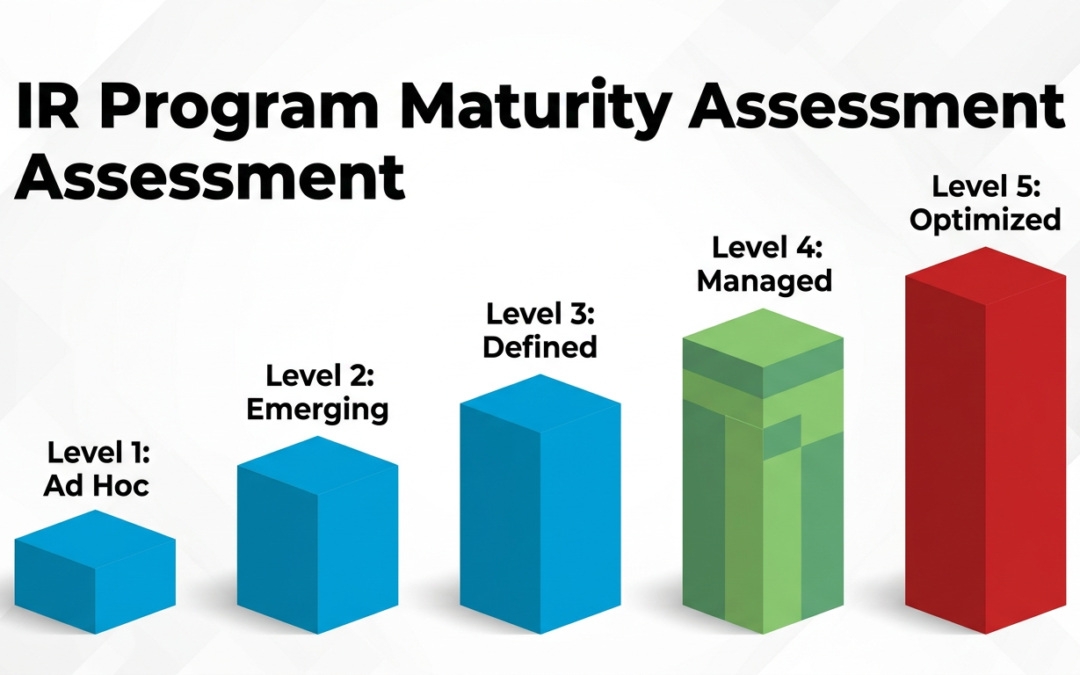
Is Your Investment Recovery Program Reaching Its Full Potential?
Every organization with surplus assets has some form of investment recovery — but the gap between a reactive disposal process and a strategically optimized IR program can mean millions in recovered value, measurable sustainability impact, and executive-level credibility. The question isn’t whether you have an IR program. It’s how mature that program really is.
The IR Program Maturity Assessment is a structured framework that helps organizations evaluate where they stand today across the dimensions that matter most — and chart a clear path toward best-in-class performance. Whether you’re a one-person operation handling surplus on the side or a fully staffed department with enterprise-wide visibility, this assessment gives you an honest, actionable snapshot of your program’s strengths and growth areas.
Why this matters: IRA member organizations that operate at the highest maturity levels consistently return $20 or more for every $1 invested in their IR programs. Organizations at lower maturity levels often leave 40–60% of potential value unrecovered.
The Five Dimensions of IR Program Maturity
A comprehensive maturity assessment evaluates your program across five interconnected dimensions. Each dimension is scored on a five-level scale, from Level 1 (Ad Hoc) to Level 5 (Optimized). Together, they paint a complete picture of program health and reveal the highest-impact areas for improvement.
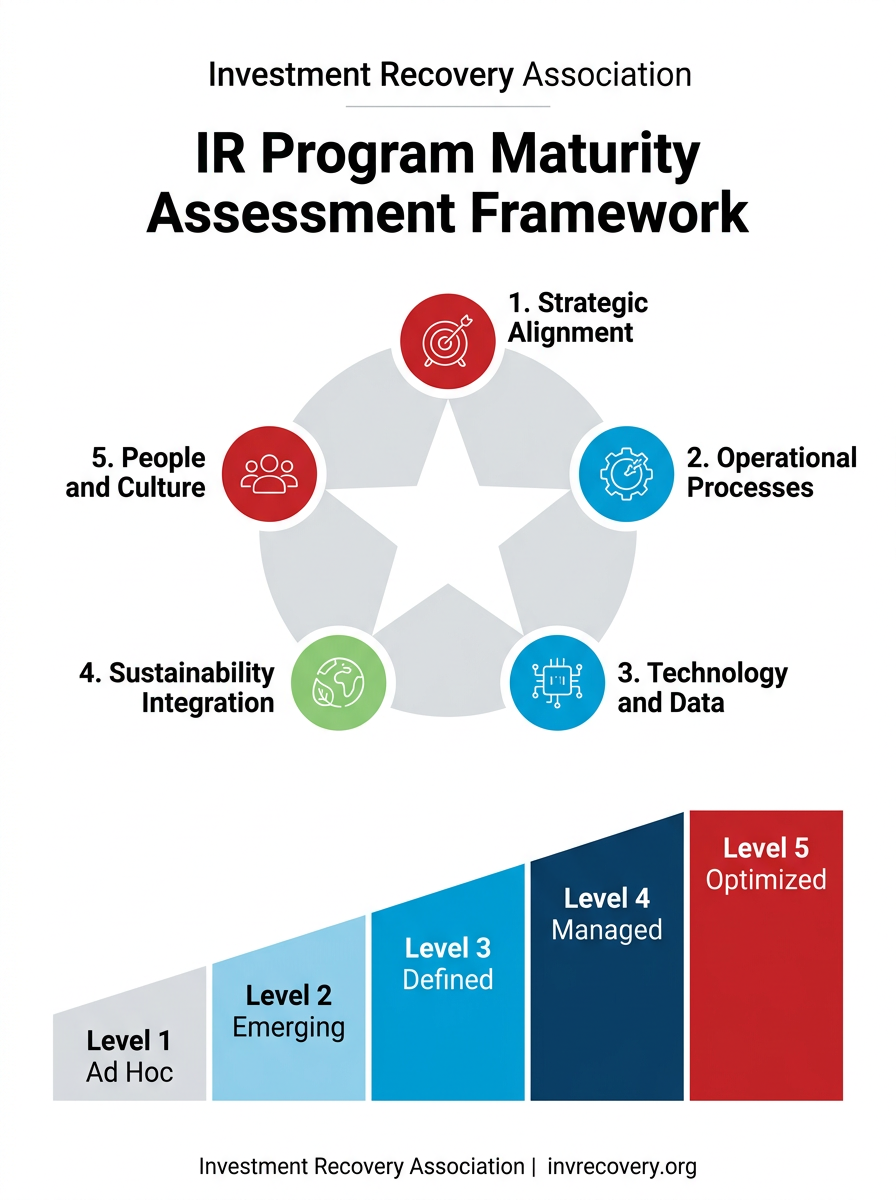
The five dimensions of IR Program Maturity — from Ad Hoc to Optimized.
1. Strategic Alignment
This dimension measures how well your IR program is connected to the broader organizational strategy. At the lowest maturity level, investment recovery is an afterthought — surplus is handled only when it becomes a problem. At the highest level, IR is a recognized strategic function with executive sponsorship, dedicated budget, clearly defined KPIs, and a direct line to corporate sustainability and financial goals.
Key questions to ask yourself:
- Does your IR program have a formal mission statement aligned to corporate objectives?
- Is there executive sponsorship or a senior leader who champions the program?
- Do you report IR results (revenue recovered, waste diverted, compliance metrics) to leadership at least quarterly?
- Is IR integrated into capital planning and asset lifecycle management decisions?
- Do procurement and operations teams proactively consult IR before purchasing or decommissioning assets?
Ad Hoc disposal → IR is a strategic pillar with executive sponsorship, defined KPIs, and board-level reporting
2. Operational Processes
Strong processes are the backbone of every high-performing IR program. This dimension evaluates how standardized, documented, and repeatable your workflows are — from asset identification and valuation to disposition execution and post-sale tracking. Mature programs don’t rely on tribal knowledge or heroic individual efforts; they have documented procedures that any trained team member can follow consistently.
Key questions to ask yourself:
- Do you have documented standard operating procedures (SOPs) for each stage of the asset disposition lifecycle?
- Is there a formal approval workflow for disposition decisions (sell, scrap, donate, repurpose)?
- Do you conduct regular asset audits to identify surplus before it becomes obsolete?
- Are disposition channels (auction, broker, direct sale, recycling) evaluated and optimized based on return data?
- Do you track cycle time from asset identification to final disposition?
3. Technology and Data
Data-driven decision-making separates top-performing programs from the rest. This dimension assesses whether you’re leveraging technology to track assets, analyze disposition outcomes, forecast surplus volumes, and demonstrate ROI. At lower maturity levels, programs rely on spreadsheets and manual tracking. At higher levels, they use integrated asset management systems with real-time dashboards, predictive analytics, and automated reporting.
Key questions to ask yourself:
- Do you use a dedicated system (or ERP module) for tracking surplus assets from identification through disposition?
- Can you pull real-time data on recovered value, cost avoidance, and landfill diversion rates?
- Do you benchmark your program’s performance against historical data and industry standards?
- Is your data clean enough to support meaningful trend analysis and forecasting?
- Do you have dashboards or reports that are shared with stakeholders on a regular cadence?
Benchmark insight: IRA’s annual survey data shows that organizations using dedicated asset management software recover 25–35% more value from surplus than those relying solely on spreadsheets.
4. Sustainability Integration
Investment recovery has become inseparable from corporate sustainability. This dimension evaluates how deeply your IR program is woven into your organization’s environmental goals — from landfill diversion tracking to circular economy initiatives to ESG reporting. The most mature programs don’t just support sustainability; they lead it, providing quantifiable data on waste reduction, carbon avoidance, and resource conservation.
Key questions to ask yourself:
- Do you track and report landfill diversion rates for all surplus materials?
- Is IR data integrated into your organization’s ESG or sustainability reporting?
- Do you follow a “landfill last” hierarchy — prioritizing reuse, resale, and recycling over disposal?
- Can you quantify the carbon footprint avoidance achieved through your IR activities?
- Does your program actively support circular economy goals by feeding materials back into the supply chain?
Sustainability leadership: IR professionals are the sustainability heroes in their organizations — the go-to authorities for keeping waste out of landfills, monetizing idle assets, and boosting the bottom line. Mature programs prove this with data.
5. People and Culture
Tools and processes only work when people are skilled, engaged, and empowered to use them. This dimension measures the investment in human capital — from training and professional development to cross-functional collaboration and organizational awareness of IR’s value. The most mature programs have certified professionals (CMIRs), dedicated headcount, and a culture where every department understands how to engage the IR team.
Key questions to ask yourself:
- Do you have dedicated IR staff, or is it handled as a secondary duty?
- Have team members earned the Certified Manager of Investment Recovery (CMIR) designation?
- Do you invest in ongoing professional development — conferences, IRA membership, training?
- Is there a cross-functional network of “IR champions” across business units who identify surplus early?
- Do employees across the organization know who to contact and what processes to follow when they have surplus assets?
The Five Maturity Levels Explained
Each dimension is scored on a consistent five-level scale. Understanding what each level looks like helps you honestly assess where your program sits today — and see exactly what the next level requires.
| Level | Name | What It Looks Like |
|---|---|---|
| 1 | Ad Hoc | Surplus handled reactively. No formal processes, tracking, or goals. IR happens when someone remembers or when assets become a physical problem. Value recovery is minimal and unmeasured. |
| 2 | Emerging | Some awareness and basic procedures exist. A designated person handles surplus, but with limited authority, budget, or visibility. Tracking is mostly spreadsheet-based. Sustainability is acknowledged but not measured. |
| 3 | Defined | Formal program with documented SOPs, regular reporting, and defined metrics. Cross-functional relationships are developing. Technology is in use for tracking and reporting. Sustainability data is beginning to be captured systematically. |
| 4 | Managed | Program is data-driven with clear KPIs, regular benchmarking, and continuous improvement cycles. IR is integrated into capital planning. Team includes certified professionals. Sustainability metrics are part of corporate reporting. |
| 5 | Optimized | Best-in-class program with executive sponsorship, enterprise-wide integration, predictive analytics, and industry-leading performance. The IR team is a recognized profit center and sustainability leader. Continuous innovation and knowledge sharing are embedded in the culture. |
How to Conduct Your Own Maturity Assessment
Running a maturity assessment doesn’t need to be a months-long consulting engagement. Here is a practical, step-by-step approach that any IR team can execute — whether you’re a department of one or twenty.
Step 1: Assemble Your Assessment Team
Include your core IR team plus key stakeholders from operations, procurement, finance, and sustainability. Getting cross-functional perspectives is critical — your program’s maturity is partly defined by how well other departments understand and engage with it.
Step 2: Score Each Dimension Independently
Have each team member score the five dimensions independently using the 1–5 scale. Use the key questions listed above as scoring guides. Independent scoring prevents groupthink and surfaces honest differences in perception.
Step 3: Discuss and Calibrate
Bring the team together to compare scores. Where there’s alignment, you have confidence. Where scores diverge, you’ve found the most valuable discussion points. Often, the IR team rates a dimension higher than the stakeholders who interact with the program externally — and that gap itself is a maturity indicator.
Step 4: Identify Your Top Two Improvement Priorities
Don’t try to advance every dimension simultaneously. Identify the two dimensions where improvement would have the highest impact on value recovery, organizational credibility, or sustainability goals. Focus there first.
Step 5: Build a 90-Day Action Plan
For each priority dimension, define two to three specific, measurable actions you’ll take in the next 90 days. Examples might include documenting your first SOP, implementing a basic tracking spreadsheet with defined fields, presenting quarterly results to leadership for the first time, or enrolling a team member in CMIR preparation.
Pro tip: Document your baseline scores and reassess every 6–12 months. Tracking maturity progress over time gives you a powerful narrative for leadership — showing not just what you deliver today, but how the program is systematically improving.
Benchmarking Against IRA Members
One of the most valuable benefits of conducting a maturity assessment is the ability to benchmark your program against industry peers. Through the Investment Recovery Association’s member network, annual surveys, and conference benchmarking sessions, you can see how your scores compare to organizations of similar size, industry, and complexity.
Here’s what IRA member data typically reveals about maturity distribution across the industry:
| Dimension | Industry Average | Top Quartile (IRA Members) | Best in Class |
|---|---|---|---|
| Strategic Alignment | 2.3 | 3.8 | 4.7 |
| Operational Processes | 2.8 | 4.0 | 4.9 |
| Technology & Data | 2.1 | 3.5 | 4.5 |
| Sustainability Integration | 2.5 | 3.9 | 4.8 |
| People & Culture | 2.4 | 3.7 | 4.6 |
These benchmarks reveal an important pattern: Technology & Data and Strategic Alignment are consistently the lowest-scoring dimensions across the industry — meaning they represent both the biggest challenge and the biggest opportunity for programs looking to differentiate themselves.
Personalized Recommendations by Maturity Level
Once you’ve scored your program, here are targeted recommendations based on where you land on the maturity spectrum.
If You’re Mostly Level 1–2 (Ad Hoc / Emerging)
Your immediate priority is establishing foundations. Focus on documenting what you currently do, even informally. Create a simple inventory of surplus asset categories, current disposition methods, and approximate volumes. Start tracking recovered value in any format — even a basic spreadsheet. The goal is visibility: you can’t improve what you can’t measure. Consider joining the Investment Recovery Association to access best practices, templates, and a peer network that can accelerate your learning curve dramatically.
If You’re Mostly Level 2–3 (Emerging / Defined)
You have the basics in place. Now it’s time to formalize and expand. Develop written SOPs for your top three disposition channels. Begin presenting IR results to management quarterly — even a one-page summary creates visibility and builds credibility. Evaluate technology options for replacing manual tracking. This is also the right time to pursue CMIR certification, which signals professional commitment and provides a structured framework for developing deeper expertise.
If You’re Mostly Level 3–4 (Defined / Managed)
Your program is solid. The opportunity now is integration and influence. Work with sustainability to ensure IR data flows into ESG reporting. Partner with capital planning to get IR involved earlier in asset lifecycle decisions — before assets become surplus. Invest in advanced analytics: build a disposition decision matrix that optimizes for financial return, environmental impact, and speed. Attend the IRA Annual Conference to benchmark against top performers and identify specific practices to adopt.
If You’re Mostly Level 4–5 (Managed / Optimized)
You’re among the industry leaders. Your focus should be on innovation, knowledge sharing, and building organizational resilience. Consider developing predictive models that forecast surplus volumes based on capital plans and maintenance cycles. Build a succession plan that ensures program maturity survives personnel changes. Share your expertise through the IRA — publish case studies, present at conferences, and mentor emerging programs. Your program’s story can inspire the next generation of IR professionals.
Making the Business Case with Your Assessment Results
A maturity assessment isn’t just an internal exercise — it’s one of the most powerful tools for building executive support. When you can show leadership exactly where your program stands relative to industry benchmarks, identify specific gaps, and present a costed improvement plan, you transform the conversation from “we need more resources” to “here’s the ROI we’ll deliver with these specific investments.”
Frame your results around three pillars that resonate with senior leadership:
- Financial impact: Quantify the value gap between your current maturity level and the next level up. If top-quartile programs recover 25–35% more value, what does that mean in dollar terms for your organization’s surplus volume?
- Risk reduction: Highlight compliance and regulatory risks that lower-maturity programs face — from improper hazardous material disposal to missed tax benefits on donations.
- Sustainability credibility: Show how maturity improvements directly support corporate ESG commitments with measurable metrics that can be reported to stakeholders and the public.
IRA members at the highest maturity levels consistently deliver this benchmark — proving the value of systematic program improvement.
Take the Next Step
The Investment Recovery Association has been helping organizations build world-class IR programs for more than 50 years. Whether you’re just starting your maturity journey or looking to move from good to great, IRA membership provides the benchmarking data, best practices, professional development resources, and peer network you need to accelerate your progress.
Start with your maturity assessment. Score your five dimensions. Identify your top two priorities. Build your 90-day plan. And connect with the only professional community dedicated entirely to helping you succeed in investment recovery.