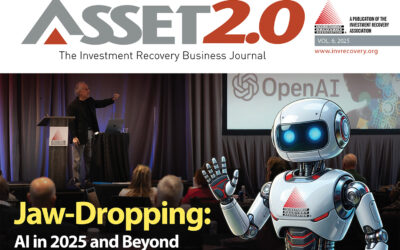
Jaw-Dropping AI in 2026 and Beyond: What It Means for Investment Recovery
In 2024, the AI conversation at the IRA conference was described as “mind-blowing.”
In 2025, one word captured the leap forward: jaw-dropping.
AI is evolving at warp speed—and it’s increasingly shaping the way we work, manage assets, and recover value from surplus.
TL;DR (AI Overview)
- AI is now a business partner, not just a productivity tool—especially for data-heavy asset programs.
- Investment recovery (IR) teams can use AI to model total cost of ownership (TCO), optimize disposition timing, improve surplus identification, and strengthen compliance.
- Governance matters: bias, “black box” decisions, privacy, data quality, and cost must be managed with clear guardrails.
- 2026 is the year of agents: expect smarter digital assistants, AI-driven robotics, and “sovereign AI” approaches that keep data local.
Why 2025 Felt “Jaw-Dropping”
The “jaw-dropping” reaction wasn’t hype—it was the realization that AI has moved from a clever tool
to a versatile partner across work, creativity, and decision-making.
In entertainment, AI supports global production of music, film, and avatars.
In business, AI increasingly helps organizations match partners, translate negotiations, and predict customer needs.
In science and healthcare, it accelerates modeling and access.
For investment recovery professionals, the takeaway is simple:
AI is becoming a competitive requirement for organizations that manage large asset portfolios, complex compliance demands,
and time-sensitive resale and disposition decisions.
AI in Everyday Life (and Work)
One of the most relatable moments from the conference AI session came from a simple question:
“What happens when you forget your phone?”
For most of us, that’s instant disruption—calls, meetings, reminders, navigation, verification, and communication all gone at once.
At work, the behavior is just as automatic. When you need answers quickly, you search—Google, copilots, and AI chat interfaces.
Whether we label it or not, AI is already embedded in daily operations.
How We Got Here: From Sci-Fi to Standard
From Dick Tracy to wearables that can save lives
In the 1940s, the comic character Dick Tracy popularized the idea of “talking through a wristwatch.”
In the modern era, smartwatches made that concept real—and expanded it into health monitoring.
Today’s wearables can detect patterns that prompt real medical intervention. The point isn’t any single device.
The point is the trajectory: AI-enabled sensing + prediction is becoming normal.
We should expect similar trajectories in enterprise asset management:
more data capture, more prediction, and more automation.
From early networks to AI-at-scale
Long before modern AI, the world shifted when digital networks made information portable and shareable.
That same pattern is repeating—faster.
Generative AI platforms scaled to massive adoption in record time, pushing organizations to respond quickly.
Real-World AI Examples That Matter
AI’s impact is easiest to understand through real examples that feel “obvious” once you see them:
- Driverless rides: fully driverless robotaxi services have expanded in major metros,
showing how autonomy is moving into everyday logistics and transportation. - Biometric identity: automated identity verification (like photo-based entry processes) reduces friction—
but also raises questions about consent and data usage. - Access control: venues and organizations can combine ticketing data and public information to enforce policies,
sometimes controversially. - Retail optimization: data patterns can reshape merchandising, product placement, and demand forecasting with measurable lifts.
These examples share a theme that matters to IR: AI turns data into operational decisions.
And in investment recovery, decisions—timing, channel, compliance, and pricing—drive returns.
AI and Investment Recovery: The TCO + Timing Advantage
One of the most practical IR examples discussed was this:
if a company is procuring a fleet of assets (like trucks), how can it forecast ROI and value recovery from day one?
This is where AI becomes more than “nice to have.” AI can support a Total Cost of Ownership (TCO) model that estimates:
purchase price, operating costs, maintenance costs, utilization, compliance risk, and end-of-life disposition outcomes.
Most importantly, it can help answer a question every IR program faces:
When is the right time to dispose to maximize recovery?
High-impact AI use cases for IR teams
- Surplus identification: detect underutilized, idle, or duplicate assets faster across sites and systems.
- Disposition timing: predict value curves and recommend when to redeploy, auction, resell, or scrap.
- Channel selection: match assets to the best-fit channel (reuse, resale, auction, ITAD, scrap) based on risk and return.
- Faster asset descriptions: generate consistent listings, condition summaries, and compliance notes for resale channels.
- Market pricing support: analyze historical recovery data and external market signals to guide reserve pricing.
- Compliance automation: flag data-security or environmental requirements earlier (especially for IT and regulated equipment).
- Negotiation support: summarize bids, compare vendor proposals, and highlight hidden terms in contracts.
- Executive reporting: create repeatable monthly dashboards that