TL;DR
- R2v3 and e-Stewards are the two leading ITAD certifications for responsible electronics recycling, and both protect your organization from compliance risk.
- R2 certification offers more flexibility and lower costs ($15K-$40K), while e-Stewards enforces stricter export controls and mandatory NAID AAA data destruction.
- For investment recovery professionals, choosing the right certification can unlock enterprise contracts and boost surplus asset value by 20-40%.
- Many top ITAD providers now hold dual certification, covering the widest range of client and regulatory requirements.
- This guide breaks down requirements, costs, timelines, and which standard best fits your investment recovery program.
Why R2 Certification and ITAD Standards Matter in 2026
The global e-waste recycling market is projected to reach $70.6 billion by 2030, growing at nearly 12% annually. For investment recovery professionals managing surplus IT assets, that growth brings both opportunity and risk. Without proper R2 certification or equivalent credentials, your organization faces regulatory penalties, data breach liability, and reputational damage. R2 certification has become the baseline that enterprise clients demand before they will even consider working with an ITAD provider.
But which certification should you pursue, or require from your vendors? The two dominant standards in electronics recycling certification are R2v3 (Responsible Recycling Standard, Version 3) and e-Stewards. Both aim to ensure responsible handling of end-of-life electronics, but they differ significantly in philosophy, requirements, and cost. Understanding these differences is essential for anyone running an ITAD program or selecting vendors for surplus asset disposition.
Projected global e-waste recycling market by 2030, growing at 11.89% CAGR
What Is R2v3 Certification?
R2v3 is the latest version of the Responsible Recycling Standard, developed and maintained by Sustainable Electronics Recycling International (SERI). Originally launched in 2008 and updated to version 3 in 2020, R2 certification has become the most widely adopted standard for electronics recycling and ITAD operations in North America.
The standard provides a framework for managing the full lifecycle of used electronics, from intake through data destruction, refurbishment, and final disposition. R2 certification recycling facilities must demonstrate compliance across four core pillars, while maintaining the flexibility to adapt processes to their specific operations.
R2v3 Core Requirements
R2v3 is built around four fundamental requirement areas that certified facilities must satisfy:
1. Data Protection: All electronic devices must be securely sanitized in compliance with regulations like GDPR and HIPAA. R2v3 mandates strict requirements for destroying data on all device types, covering both logical sanitization (software-based wiping) and physical destruction methods. The approach is risk-based, meaning facilities assess and mitigate data security risks proportional to the sensitivity of the data involved.
2. Environmental Management: R2v3 enforces strict guidelines for handling hazardous materials to minimize environmental impact. The EPA recognizes both R2 and e-Stewards as credible certification programs. Certified facilities cannot send hazardous electronic waste to landfills, preventing toxic chemicals from leaching into soil and groundwater. Facilities must integrate either ISO 14001 (environmental management) or an equivalent environmental management system.
3. Hierarchy of Responsible Practices: The standard establishes a clear priority order: reuse and refurbishment first, then material recovery and recycling when reuse is not feasible. This hierarchy aligns directly with circular economy principles that investment recovery professionals champion daily.
4. Chain of Custody and Accountability: Certified recyclers must meticulously track and audit all downstream partners. Every vendor that touches material after it leaves the facility must be verified, creating a transparent chain of accountability from intake to final disposition.
Key Distinction: R2v3 also requires certification to ISO 45001 (occupational health and safety), making it one of the few ITAD standards that explicitly addresses worker safety alongside environmental and data security concerns.
R2v3 Certification Cost and Timeline
Getting R2 certified typically takes 6 to 12 months from start to finish, depending on your facility’s existing processes. Organizations that already have strong quality management systems may achieve certification in as little as 4-6 months.
Total costs generally range from $15,000 to $40,000, which includes:
A non-refundable $150 SERI license application fee, an annual $2,000 SERI/R2 license, ISO 14001 and ISO 45001 standard purchases (approximately $150 each), certification body audit fees, and optional consulting support. Facilities that already hold ISO certifications will be on the lower end of this range. For investment recovery professionals evaluating the ROI, R2-certified facilities consistently command 20-40% higher prices on surplus IT assets and win enterprise contracts that uncertified competitors cannot access.
What Is e-Stewards Certification?
The e-Stewards standard was created in 2009 by the Basel Action Network (BAN), a nonprofit environmental organization focused on preventing the export of toxic waste to developing countries. Now in version 4.1, the e-Stewards electronics recycling certification is widely regarded as the most rigorous environmental standard in the ITAD industry.
Where R2v3 emphasizes flexibility with accountability, e-Stewards takes a prescriptive approach. The standard sets strict, non-negotiable rules that must be applied consistently across all facilities, with no exceptions for operational differences.
e-Stewards Core Requirements
Basel Convention Compliance: The e-Stewards standard explicitly requires full compliance with the Basel Convention, the international treaty governing transboundary movement of hazardous waste. This means certified facilities face strict limits on exporting e-waste, with shipments permitted only to countries that are Basel Convention signatories. This is the single biggest differentiator from R2v3.
Mandatory NAID AAA Certification: Unlike R2v3’s risk-based approach, e-Stewards requires all processors to hold NAID AAA certification, the highest standard available for data destruction. There is no flexibility on this point.
All Facilities Must Be Certified: If your company operates multiple ITAD facilities, e-Stewards requires every single location to be certified. R2v3 does not have this all-or-nothing requirement.
Enhanced Oversight: Certified organizations must undergo unannounced inspections and GPS tracking audits coordinated by BAN. These surprise audits are designed to catch non-compliance that scheduled audits might miss. Downstream vendor management is equally rigorous, requiring documented due diligence for every vendor in the recycling chain.
Sustainability Impact: Extended Producer Responsibility (EPR) schemes in the EU, India, and South Korea directed approximately 2.1 million tons of e-waste into certified processing plants during 2024, establishing formal revenue streams for certified processors and pushing the industry toward higher standards.
R2 Certification vs. e-Stewards: Head-to-Head Comparison
For investment recovery professionals choosing between these two standards, or evaluating which certification to require from vendors, the differences come down to six key areas. Here is a detailed side-by-side comparison of R2 certification and e-Stewards across every dimension that matters for your ITAD program:
| Criteria | R2v3 (SERI) | e-Stewards (BAN) |
|---|---|---|
| Governing Body | Sustainable Electronics Recycling International (SERI) | Basel Action Network (BAN) |
| Current Version | R2v3 (released 2020) | Version 4.1 |
| Flexibility | Allows custom processes within framework; risk-based approach | Prescriptive rules applied uniformly; no exceptions |
| Export Controls | Allows exports to developed countries under controlled conditions | Strict Basel Convention compliance; exports only to signatory countries |
| Data Destruction | Risk-based data security requirements | Mandatory NAID AAA certification required |
| Facility Coverage | Per-facility certification; not all locations required | All corporate ITAD facilities must be certified |
| Audit Approach | Scheduled audits by SERI-approved certification body | Scheduled audits plus unannounced inspections and GPS tracking |
| Estimated Cost | $15,000 – $40,000 | $25,000 – $60,000+ (higher due to NAID AAA and multi-facility requirements) |
| Timeline | 6-12 months | 8-14 months |
| Base EMS Required | ISO 14001 + ISO 45001 | ISO 14001 or RIOS |
Export and Downstream Controls
This is where the two certifications diverge most sharply. R2v3 allows the export of e-waste to developed countries under controlled, documented conditions. The standard requires transparent tracking and vendor verification, but it does not impose a blanket ban on international shipments.
e-Stewards, by contrast, was born out of the Basel Action Network’s core mission to stop the flow of toxic waste to developing nations. The standard requires strict adherence to the Basel Convention, meaning exports are only permitted to countries that are signatories to the treaty. For organizations with international supply chains or data center decommissioning projects spanning multiple countries, this distinction matters enormously.
Data Security Requirements
Both standards take data security seriously, but they approach it differently. R2v3 uses a risk-based model: facilities assess the data sensitivity level of incoming devices and apply proportional controls. For a facility handling mostly low-risk consumer electronics, the requirements are different from one processing servers from a healthcare provider. This flexibility makes R2 certification practical for a wide range of operations.
e-Stewards eliminates that flexibility by requiring NAID AAA certification for all data destruction activities. NAID AAA is the highest independently verified standard for data destruction, requiring regular unannounced audits and strict process controls. If your ITAD program processes sensitive data from regulated industries like healthcare, finance, or government, the e-Stewards approach to an itad certificate may provide the level of assurance your clients require.
Which R2 Certification Is Right for Your ITAD Program?
The right choice depends on your organization’s specific situation, client base, and strategic goals. Here is a practical decision framework for investment recovery professionals:
Choose R2v3 if: You need a flexible, cost-effective certification that meets the requirements of most enterprise clients. R2v3 is the more widely recognized standard in North America, and its risk-based approach adapts well to diverse operations. If your itad program handles a mix of equipment types and your clients prioritize transparency and documented processes, R2v3 delivers strong value at a predictable cost.
Choose e-Stewards if: Your clients operate in highly regulated industries or have strict ESG compliance requirements. The mandatory NAID AAA certification and Basel Convention compliance signal the highest level of rigor. Government agencies, healthcare systems, and multinational corporations often prefer or require e-Stewards-certified vendors.
Consider Dual Certification if: You want to serve the broadest possible market. Many leading ITAD providers now hold both R2v3 and e-Stewards certifications, which allows them to bid on any contract regardless of the client’s certification preference. The incremental cost of adding a second certification is typically 30-50% less than the first, since much of the foundational work (EMS, processes, documentation) overlaps.
Pro Tip: When evaluating ITAD vendors for your investment recovery program, ask to see their most recent audit reports, not just their certificates. A current R2 certification or e-Stewards certification with clean audit findings tells you far more than the certificate hanging on the wall.
How R2 Certification Strengthens Investment Recovery Programs
For investment recovery professionals, ITAD certifications are not just a compliance checkbox. They are a direct lever for maximizing the value recovered from surplus assets. Here is how R2 certification and e-Stewards create tangible returns:
Higher Asset Values: Certified ITAD vendors consistently command 20-40% higher prices on refurbished equipment because buyers trust the provenance and data sanitization processes. When your investment recovery program routes surplus IT assets through certified channels, you capture more of that value.
Enterprise Contract Access: Fortune 500 companies, government agencies, and healthcare systems increasingly require R2 certification or e-Stewards certification as a minimum qualification for ITAD vendors. Without certification, your vendors are locked out of the highest-value contracts.
ESG and Sustainability Reporting: Working with certified ITAD providers generates documented sustainability metrics, including diversion rates, carbon savings, and responsible recycling volumes, that feed directly into your organization’s ESG reporting. Investment recovery returns $20+ for every $1 invested, and certified disposition strengthens the sustainability story behind those numbers.
Regulatory Protection: With e-waste regulations tightening globally, using certified vendors provides a documented defense against liability. If a downstream processor mishandles material, your organization’s due diligence in selecting a certified partner demonstrates responsible oversight.
Investment recovery delivers outsized returns when supported by certified ITAD processes
Getting Started: Steps to R2 Certification
Whether you are pursuing R2 certification for your own facility or helping evaluate vendors, here is the practical roadmap. These steps apply to both R2v3 and e-Stewards, with the specific requirements differing as outlined above.
Step 1 – Gap Assessment: Evaluate your current processes against the R2v3 standard requirements. SERI provides free online training resources in their R2 Knowledge Base. Many organizations also engage consultants for a formal readiness assessment, which typically costs $3,000-$8,000.
Step 2 – SERI License Application: Submit the online license application at least 30 days before your planned audit. The non-refundable fee is $150, plus a $2,000 annual license. For itad course materials and preparation guides, SERI’s website offers comprehensive resources.
Step 3 – Implement and Document: Build or update your management system to address all R2v3 requirements: data security protocols, environmental controls, worker safety procedures (ISO 45001), and downstream vendor verification processes. This is typically the longest phase, taking 3-6 months.
Step 4 – Certification Audit: A SERI-approved certification body conducts a two-stage audit. Stage I reviews documentation and readiness. Stage II is an on-site assessment of actual operations. A verification audit confirms corrective actions before the certificate is issued.
Step 5 – Maintain and Improve: R2 certification requires ongoing surveillance audits and continuous improvement. Consider pairing your R2 certification with the CMIR (Certified Manager of Investment Recovery) credential to demonstrate both technical ITAD competence and strategic investment recovery expertise.
For investment recovery teams evaluating the landscape, the E-Waste and ITAD Trends report provides additional context on how certification requirements are evolving across the industry.
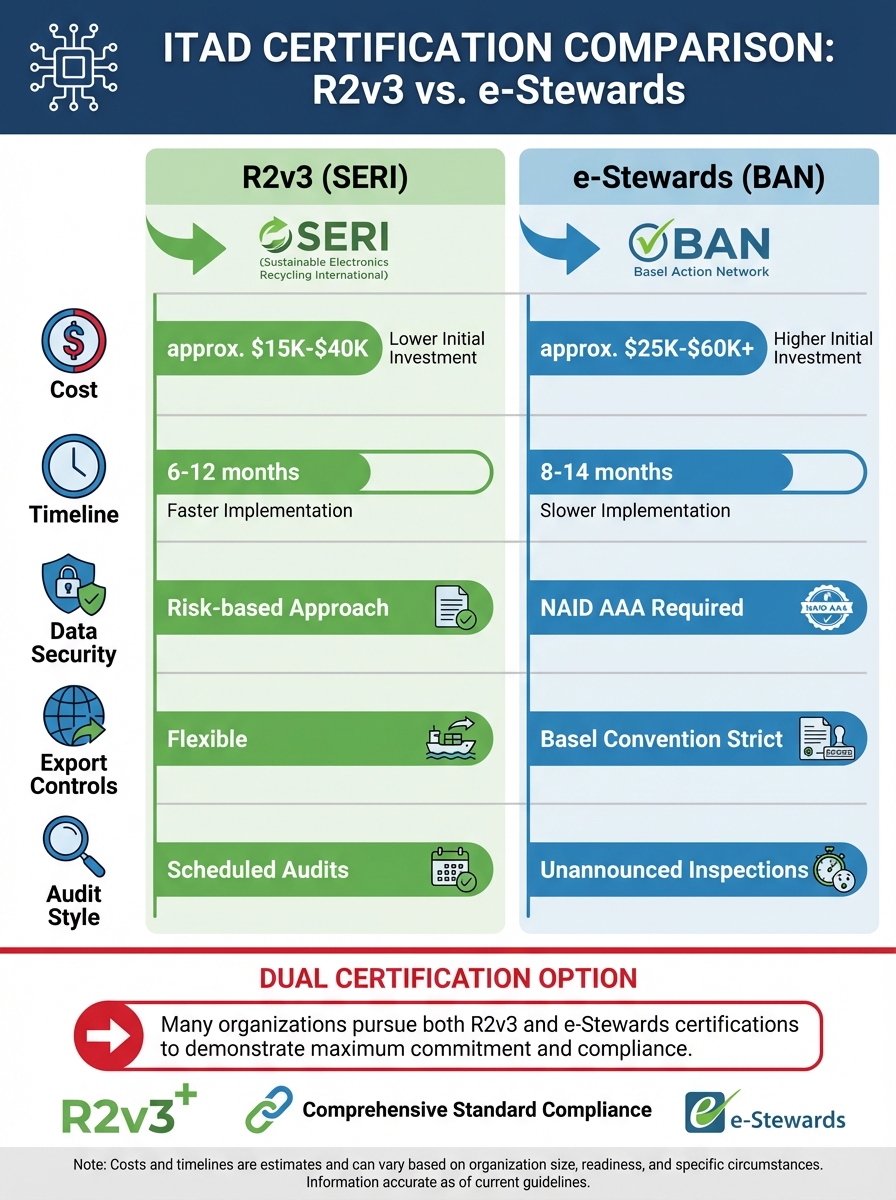
R2v3 vs. e-Stewards: A visual comparison of the two leading ITAD certification standards.