
TL;DR
- The tariff impact on surplus assets is massive in 2026: Chinese goods now face effective tariff rates of 40% to 145%, and the average U.S. tariff rate is the highest since the Smoot-Hawley Act of 1930.
- Warehouses across the country are overflowing with tariff excess inventory that importers cannot profitably sell, creating an urgent need for strategic asset liquidation.
- Used and surplus equipment demand is surging as buyers seek domestic alternatives to tariffed imports, driving up recovery values for sellers who act quickly.
- Investment recovery professionals who reposition their programs now can capture premium pricing, accelerate disposition timelines, and demonstrate strategic value to leadership.
- Five proven strategies can help you navigate the tariff economy, from accelerated liquidation to cross-border trade compliance optimization.
The Tariff Impact on Surplus Assets: A 2026 Crisis Unfolds
The tariff impact on surplus assets has never been more significant than it is right now. With Chinese goods facing combined duties of 40% to 145% under Section 301 and IEEPA tariff programs, the average U.S. tariff rate has climbed to approximately 17%, the highest level since the Smoot-Hawley Tariff Act of 1930. For investment recovery professionals already tracking 2026 trends, this represents both an unprecedented disruption and a once-in-a-generation opportunity.
The numbers tell a stark story. One equipment appraiser recently cited an example where the cost of an imported machine increased 29% when tariffs were applied. On a $500,000 machine, that represents an extra $145,000 in acquisition cost that may never be recoverable on disposition. Across industries, from manufacturing to healthcare to technology, organizations are rethinking every aspect of how they acquire, deploy, and dispose of assets.
The highest since the Smoot-Hawley Act of 1930, reshaping surplus asset markets nationwide
This is not a temporary blip. On March 11, 2026, the Office of the United States Trade Representative (USTR) initiated new Section 301 investigations targeting 16 economies, including China, the European Union, and Singapore. USTR intends to complete these investigations by approximately July 24, 2026, potentially expanding tariffs even further. For investment recovery departments, the message is clear: the tariff economy is the new normal, and your asset management strategies need to evolve accordingly.
The Tariff Landscape: What Investment Recovery Professionals Need to Know
Understanding the current tariff structure is essential for making informed asset disposition decisions. Two major tariff programs are reshaping surplus equipment markets simultaneously.
Section 301 and IEEPA: The Double Hit
Section 301 tariffs, originally imposed to address China’s unfair trade practices, have been steadily escalating. Combined with tariffs under the International Emergency Economic Powers Act (IEEPA), many product categories now face cumulative duty rates that make imported goods commercially unviable. The result is a growing mountain of tariff excess inventory sitting in warehouses across the country.
These tariffs affect virtually every asset category that investment recovery professionals handle. Cables, chargers, audio equipment, smart home devices, and IT peripherals heavily sourced from China are sitting in surplus nationwide. Large, high-tariff items like industrial equipment and furniture are particularly costly to store, making liquidation especially urgent.
New Section 301 Investigations Targeting 16 Economies
The March 2026 USTR announcement of new investigations targeting structural excess capacity in manufacturing across 16 trading partners signals that tariff disruptions will likely intensify. These investigations cover sectors directly relevant to investment recovery, from industrial machinery to electronics. With results expected by July 2026, organizations have a narrow window to adjust their surplus asset disposition strategies before the next wave of tariffs potentially lands.
Key Distinction: Tariff excess inventory refers specifically to imported goods that have become commercially unviable due to new or higher tariffs. This is different from traditional surplus inventory created by overproduction or demand shifts. The strategies for handling each require different approaches.
Understanding the Tariff Impact on Surplus Assets, Equipment Values, and Markets
The tariff impact on surplus assets extends well beyond simple cost increases. Tariffs create price fluctuations that can cause traditional valuation guides to become outdated within weeks. Professional appraisers who understand current market conditions and tariff implications are becoming essential for determining real-world asset values.
The Tariff Excess Inventory Crisis
Sweeping tariffs on Chinese-manufactured goods have triggered a genuine crisis in warehouses across America. Businesses that placed orders months ago are now sitting on mountains of stock they cannot profitably sell. The affected categories span nearly every industry: consumer electronics, industrial components, furniture, clothing, and medical equipment.
For investment recovery professionals tracking market economics, the liquidation math is sobering. Fast-moving consumer goods in good condition typically recover 30% to 60% of original cost through excess inventory liquidation channels. But the longer companies wait, the worse those numbers get. As more importers flood the liquidation market with similar goods over the next six to twelve months, prices will compress further.
Typical recovery rate for fast-moving consumer goods through liquidation channels. Delays reduce this further.
Used Equipment Demand Surge: The Silver Lining
Here is where the opportunity lives for investment recovery professionals. When tariffs inflate the price of new imported equipment, the price gap between new and used widens dramatically. A new foreign CNC machine with a hefty tariff surcharge suddenly makes that surplus process equipment in your yard look very attractive to buyers.
This shift is already driving increased demand for used machinery through professional platforms and specialized surplus marketplaces. U.S. used machinery dealers are seeing higher inquiry volumes, and organizations with well-managed equipment liquidation programs are positioned to capture premium pricing. The key is recognizing that your surplus equipment is now worth more, not less, in a tariff-driven market.
5 Strategies for Investment Recovery Professionals in a Tariff Economy
Navigating the tariff impact on surplus assets requires proactive, data-driven strategies. Here are five approaches that leading investment recovery programs are deploying right now to turn tariff disruption into competitive advantage.
Strategy 1: Accelerate Asset Liquidation Timelines
The cardinal rule in a tariff economy: move early. The earlier you engage the asset liquidation market, the better your recovery rate. Importers who act in the first wave of a surplus cycle consistently outperform those who adopt a wait-and-see approach. Every dollar tied up in unsellable overstock is a dollar you cannot redeploy into your next purchase order or capital project.
A liquidation today at 50 cents on the dollar may yield far more net cash than holding for 12 months hoping for a better deal, especially when storage, insurance, and depreciation costs compound daily. Work with your finance team to model the true carrying cost of surplus assets and set aggressive but realistic recovery targets.
Strategy 2: Prioritize Internal Redeployment Over External Sales
Before routing surplus equipment to external buyers, check whether another division, facility, or project within your organization could use it. With tariffs making new imported equipment 29% or more expensive, redeploying existing assets internally avoids both the tariff premium on replacement purchases and the disposition cost of selling externally. This strategy directly supports sustainable asset management goals while delivering immediate cost avoidance.
Sustainability Win: Internal redeployment of surplus equipment avoids both the carbon footprint of manufacturing new replacements and the environmental cost of disposition. In a tariff economy, the most sustainable asset is the one already on your floor.
Strategy 3: Leverage the Used Equipment Market Demand Spike
The tariff-driven demand spike for used domestic equipment is a window of opportunity that will not last forever. As supply chains gradually adapt through reshoring, nearshoring, and supplier diversification, the current premium pricing for surplus equipment will normalize. Investment recovery professionals should audit their surplus equipment inventories now, prioritize high-demand categories like industrial machinery, IT infrastructure, and process equipment, and bring them to market while buyer urgency is high.
Consider using structured, professional platforms like online industrial auctions rather than ad hoc disposal methods. The increased buyer pool driven by tariff avoidance is most concentrated on these platforms, where professional presentation and strategic inventory photography can further maximize recovery values.
Strategy 4: Update Asset Valuations for Tariff-Adjusted Markets
Traditional price guides and historical valuation benchmarks may no longer reflect actual market conditions. Tariffs create rapid fluctuations that demand professional, real-time appraisals. The replacement cost approach to valuation, which compares the value of an asset against the cost of acquiring a comparable new one, now must account for tariff premiums on new imports.
This means surplus assets may actually be worth more than your books suggest. A used CNC machine that was valued at $200,000 six months ago might now be worth $250,000 or more if its tariffed new equivalent costs 29% above the previous price. Update your asset registers, engage qualified appraisers, and ensure your disposition strategies reflect current market reality.
Strategy 5: Optimize Cross-Border Disposition with Trade Compliance
For organizations with global operations, cross-border equipment disposition adds layers of complexity in a high-tariff environment. However, it also opens mitigation opportunities. Free trade zones (FTZs), duty drawback programs, and careful HTS classification review are among more than 20 methods organizations can use to reduce tariff exposure on equipment moving across borders.
Work closely with your trade compliance team to identify assets that qualify for preferential treatment. A systematic four-lever strategy covering value engineering, trade compliance optimization, sourcing diversification, and strategic pricing can cut tariff-related costs by 40% to 80%, according to supply chain management research.
| Strategy | Timeline | Potential Impact |
|---|---|---|
| Accelerate Liquidation | Immediate | 30-60% recovery vs. declining value |
| Internal Redeployment | 1-4 weeks | 29%+ cost avoidance on replacements |
| Leverage Used Equipment Demand | Q2-Q3 2026 | Premium pricing window |
| Update Valuations | Ongoing | Accurate ROI reporting |
| Cross-Border Optimization | 2-8 weeks | 40-80% tariff cost reduction |
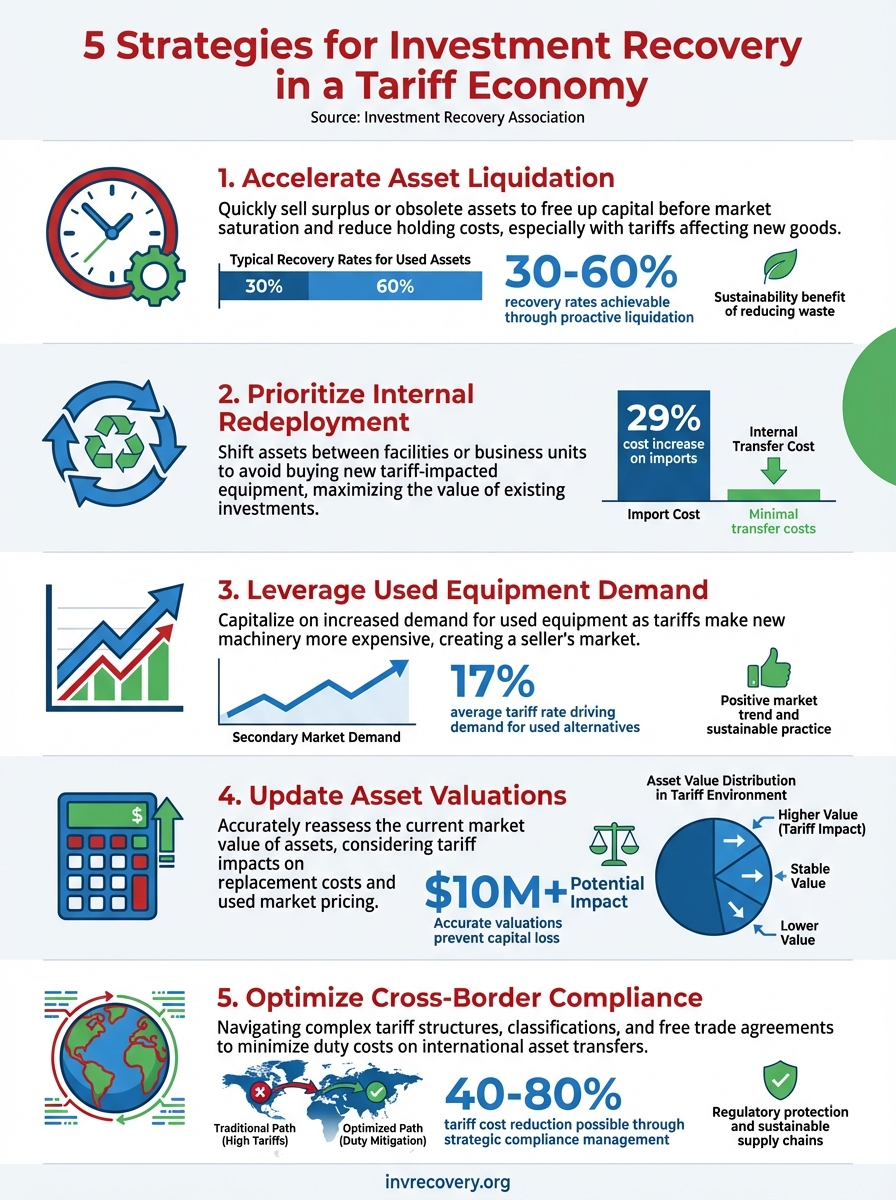
Five strategies for investment recovery professionals navigating the 2026 tariff economy.
The Reshoring Effect: How Tariffs Are Changing the Asset Lifecycle
Tariffs are accelerating a fundamental shift in how companies think about their supply chains, and this has direct implications for surplus asset management. According to recent industry research, 40% of U.S. companies planned to relocate at least part of their supply chains to North America by 2026. That reshoring activity is now underway, with sectors like steel, appliances, EV batteries, semiconductors, and renewable energy equipment seeing the most movement.
For investment recovery professionals, reshoring creates a dual opportunity. First, companies decommissioning overseas operations need to manage the disposition of assets at closing facilities. Second, new domestic manufacturing facilities need equipment, and tariffed import prices make sourcing refurbished surplus equipment an increasingly attractive option.
However, reshoring is not without challenges. Nearly 500,000 manufacturing jobs remain unfilled because modern facilities require digital, robotics, and AI skills that current training pipelines cannot supply at scale. Companies are accelerating investments in automation and AI-driven production systems to offset rising labor costs, and this creates its own cycle of surplus: as automation replaces older equipment, that displaced equipment enters the secondary market.
What This Means for Your Investment Recovery Program
The tariff impact on surplus assets is elevating investment recovery from a back-office function to a boardroom-level strategic priority. Boards of directors are increasingly involved in key decisions around capital expenditure allocation and supply chain resilience. When every imported replacement costs 29% more than it did last year, the CFO starts paying close attention to what the IR team can recover from existing surplus.
This is your moment. Investment recovery has always delivered outsized returns, with well-managed programs generating $20 or more for every $1 invested. In a tariff economy, that return is even more compelling because the cost avoidance from internal redeployment and the premium pricing from selling into a demand-constrained market both amplify the value of a professional IR program.
Take action now: audit your surplus equipment inventory, update your asset valuations to reflect tariff-adjusted replacement costs, engage your trade compliance team on cross-border opportunities, and bring high-demand categories to market before the current pricing window closes. The organizations that treat tariff disruption as an opportunity rather than a problem will emerge with stronger, more resilient asset recovery programs.
The Circular Economy Connection: Tariffs that make new imports expensive naturally push organizations toward reuse, refurbishment, and internal redeployment of surplus assets. This aligns perfectly with circular economy principles and ESG reporting goals. Investment recovery professionals are uniquely positioned to demonstrate that sustainability and financial performance are not competing priorities; in a tariff economy, they reinforce each other.