TL;DR
- Right to repair laws are now enforceable for a quarter of Americans. Since 2024, eight states have enacted comprehensive consumer electronics right to repair laws, pushing coverage past one third of the population.
- For investment recovery teams, the practical effect is simple: repairable assets grade higher, resell for more, and stay in service longer.
- The opportunity is large. The world left 62 billion dollars of recoverable resources unrecycled in a single year, and the IT asset reuse market reaches 33.4 billion dollars by 2035.
- A repair-first workflow pays twice: higher financial recovery and lower Scope 3 emissions, since extending one laptop’s life by three years avoids about 300 kg of manufacturing carbon.
- This playbook gives you the laws, the value math, the compliance guardrails, and a 90-day plan to put it to work.
For most of the last decade, repair was a side conversation in asset management. In 2026 it became a legal and financial event. Right to repair laws are now on the books in eight states, enforceable for roughly a quarter of the United States population, and for the professionals who recover value from surplus and retired equipment, that changes the math on nearly every disposition decision. When a device can legally and practically be repaired, it grades higher, sells faster, and keeps more value inside your organization instead of leaking out as scrap.
This guide is written for investment recovery professionals, ITAD managers, sustainability directors, and corporate asset managers who need to understand what right to repair laws actually require, where the recoverable value sits, and how to redesign a recovery workflow around repair as a first option. If you are newer to the field, our guide on what investment recovery is sets the foundation this article builds on.
Laws and regulations can vary significantly by state, product category, date of manufacture or sale, and type of transaction, so IR teams should verify that a specific asset is covered before relying on a state right-to-repair requirement.
Why Right to Repair Laws Are a 2026 Inflection Point for Asset Recovery
Right to repair laws require manufacturers to make the parts, tools, documentation, and software needed for repair available to owners and independent service providers on fair and reasonable terms. The goal is to break the closed loop where only the original manufacturer can fix a product, which has historically pushed perfectly serviceable equipment toward early retirement and the scrap pile.
The state patchwork now covers a quarter of Americans
Since 2024, eight states have enacted electronics right to repair laws: New York, Minnesota, California, Oregon, Colorado, Connecticut, Texas, and Washington. According to consumer advocates, coverage reached 25.75 percent of Americans on January 1, 2026 and rises to at least 35.5 percent once the Texas law takes effect in September 2026. More than 33 right to repair bills were introduced across 13 states in the first weeks of January alone, so the direction of travel is clear even where laws are not yet final.
Why a patchwork still matters: Most manufacturers will not build separate repair programs for each state. Once a parts and documentation channel exists to satisfy the strictest state, it tends to become available nationwide. Recovery teams in non-covered states often benefit from laws they are not even subject to.
What the laws require manufacturers to share
The 2026 generation of these statutes has tightened the definitions in ways that directly help asset recovery. Manufacturers may not use software locks to block access to parts or tools, or to control who is allowed to perform a repair. The definition of tools has been expanded to include software, data files, activation mechanisms, and the security credentials required to complete a repair. In practice this means a device that was previously stranded by a firmware mismatch, a calibration lock, or missing documentation can now be returned to working, resellable condition.
Penalties and compliance deadlines that change the calculus
Enforcement is real and the numbers are not trivial. New York allows civil penalties of up to 500 dollars per violation. California escalates from 1,000 dollars per day for a first violation to 2,000 and then 5,000 dollars per day for repeat conduct. Colorado allows penalties of up to 20,000 dollars per violation, and Oregon up to 1,000 dollars for each day a violation continues. Minnesota’s Digital Fair Repair Act mandates that manufacturers share the software, diagnostics, and documentation needed for repair with independent providers. For recovery teams, the takeaway is not the penalty schedule itself but what it signals: parts and tools that were once unavailable will increasingly be obtainable, which expands what you can profitably refurbish and remarket.
The Hidden Value Right to Repair Unlocks in Retired Assets
The financial case for repair-first recovery rests on a simple observation. A device that can be returned to full function is worth far more than the same device sold as parts or scrap. Right to repair removes many of the artificial barriers that used to force the lower-value outcome.
Repairable devices grade higher and resell for more
In any remarketing channel, condition grade drives price. High-specification refurbished equipment can deliver roughly 95 percent of the performance of a new unit at about 60 percent of the cost, and refurbished IT gear typically saves buyers 30 to 50 percent versus new. When repair access lets you fix a single failed component instead of writing off the whole asset, you move that unit up a grade, and grade improvements often translate into double-digit percentage gains in recovery value. Our guide to remarketing IT assets for maximum returns covers how grading and channel selection interact.
Recoverable resources left unrecycled worldwide in a single year, according to the UN Global E-waste Monitor 2024
The e-waste value gap: 62 million tonnes and 91 billion dollars
The scale of the missed opportunity is hard to overstate. The world generated a record 62 million tonnes of e-waste in 2022, up 82 percent since 2010 and on track to reach 82 million tonnes by 2030. Only 22.3 percent of that mass was formally collected and recycled, leaving 62 billion dollars of recoverable natural resources unaccounted for. The raw materials embedded in that e-waste were valued at 91 billion dollars, yet only 19 billion dollars was recovered through sound recycling. Every device that repair keeps in service is a device that never enters that leaking funnel. For a fuller picture of the trends behind these numbers, see our e-waste and ITAD trends playbook.
Reuse over recycling as the recovery hierarchy
Recycling recovers materials, but it destroys the assembled value of a product: the engineering, the labor, and the functional life still left in it. Reuse and repair preserve that value. The recovery hierarchy that maximizes both dollars and environmental benefit runs repair first, then refurbish and redeploy, then remarket on the secondary market, and only then recycle for materials. Right to repair laws strengthen the top of that hierarchy, which is exactly where the most value lives. This mirrors the logic in our overview of the circular economy in investment recovery.
How Right to Repair Laws Change the Investment Recovery Workflow
Knowing the value exists is not the same as capturing it. Right to repair laws are most useful when they are built into the recovery workflow itself, so that repair is evaluated before disposition is decided rather than after.
Inventory and triage with repair as a first option
The first change is at intake. Instead of sorting incoming surplus into working and non-working, triage into three buckets: ready to remarket, repairable to a higher grade, and end of life. The middle bucket is where repair access pays off, and it is usually larger than teams expect once parts and tools are obtainable. A disciplined intake process, like the one in our end-of-life ITAD best practices guide, keeps this triage consistent and auditable.
Access to parts, tools, and diagnostics for in-house teams
Right to repair laws give internal recovery teams and their service partners a path to the genuine parts, schematics, and diagnostic software that were previously locked behind OEM-only channels. The practical move is to inventory which of your highest-volume asset categories are now covered, then establish standing access to the parts and tools for those categories. Even modest repair capability, focused on the two or three highest-value failure modes, can lift recovery on a large share of incoming volume.
Choosing repair, refurbish, remarket, or recycle
Every asset should pass through a clear decision rule. Repair when the cost of parts and labor is well below the grade uplift it unlocks. Refurbish and redeploy when the asset has internal demand. Remarket when there is no internal use but strong secondary demand. Recycle only when none of the above clears a value threshold. Our breakdown of asset disposition strategy and our overview of asset recovery services for end-of-life equipment walk through how to set those thresholds.
Reuse beats recycling: Reuse strategies can cut e-waste generation by roughly 70 percent compared with disposal. A repair-first workflow is therefore one of the highest-leverage sustainability moves an asset manager can make, with no trade-off against financial recovery.
Compliance, Data Security, and Documentation
Repair access expands what you can recover, but it does not relax the obligations that protect your organization. If anything, more devices moving toward reuse means more attention to data security and documentation, not less.
Repair access does not replace data sanitization
A device that will be repaired and resold still carries whatever data it held. Right to repair changes the disposition path, not the data obligation. Every asset that leaves your control should be sanitized to a recognized standard, with verification, before it is remarketed. The repair-first model actually raises the stakes here, because reuse means the device will have a second owner who must never see your data.
Certificates, chain of custody, and ITAD certifications
Documentation is what turns a defensible process into a provable one. Maintain chain-of-custody records from intake through final disposition, capture certificates of data destruction, and work with partners who hold recognized credentials. Our comparison of ITAD certification standards and our broader complete guide to IT asset disposition explain what to require from a vendor and what to keep in your own records.
Warranty, liability, and OEM relationship considerations
Independent repair raises reasonable questions about warranty status and liability for repaired units sold into the secondary market. The answer is process discipline: document what was repaired, with which parts, and to what standard, and set clear as-is or limited-warranty terms for resold assets. Done well, this protects both the buyer and your organization, and it builds the trust that keeps remarketing channels paying premium prices.
The Sustainability and ESG Case for Repair-First Recovery
The financial argument for right to repair is strong on its own. The sustainability argument makes it close to unanswerable, because the two point in the same direction instead of competing.
Carbon avoided by extending device lifespan
Most of a device’s lifetime carbon footprint is embedded in its manufacture, not its use. Extending the life of a single laptop by three years avoids roughly 300 kilograms of carbon emissions tied to making a replacement. Multiply that across an enterprise fleet and the repair-first decision becomes a material lever in a corporate decarbonization plan, not a rounding error.
Scope 3, circular economy, and ESG reporting
Purchased goods and end-of-life treatment both sit in Scope 3, which is where most organizations carry the majority of their emissions. Keeping assets in service through repair reduces both new-purchase emissions and disposal emissions at once, and it generates the documented reuse data that ESG reports increasingly demand. Our Scope 3 emissions reduction playbook and our guide to ESG-compliant asset lifecycle management show how to capture and report that impact.
Turning repairability into a corporate sustainability story
Investment recovery professionals are uniquely placed to translate operational decisions into reported sustainability outcomes. A repair-first program produces a clear narrative: assets kept in service, tonnes of e-waste avoided, carbon emissions prevented, and resources kept in the circular loop. That story strengthens the case for funding the recovery function itself, a point we develop in our look at the ROI of green asset management.
A Practical Right to Repair Playbook for IR Professionals
Strategy only matters when it ships. Here is a concrete way to put right to repair to work in one quarter, along with the metrics to prove it and the mistakes to avoid.
A 90-day repair-first program checklist
| Phase | Focus | Key actions |
|---|---|---|
| Days 1 to 30 | Assess | Map your highest-volume asset categories, identify which are covered by right to repair laws, and baseline current recovery rates and scrap volumes. |
| Days 31 to 60 | Enable | Secure parts, tools, and diagnostics for the top failure modes, add a repairable bucket to intake triage, and set repair-versus-recycle value thresholds. |
| Days 61 to 90 | Operate | Run repaired assets through grading and remarketing, capture data-sanitization certificates, and report recovery value and carbon avoided to stakeholders. |
Metrics and KPIs that prove recovery ROI
Track a small set of numbers that connect repair activity to outcomes: repair conversion rate, the share of intake moved from scrap to resale; grade uplift, the average increase in condition grade after repair; recovery value per asset, before and after the program; and carbon avoided, estimated from extended-life factors. Reported together, these turn a workflow change into a defensible business case. The broader context for where these metrics are heading sits in our review of 2026 investment recovery trends.
Common mistakes that leave value on the table
Three errors recur. The first is treating repair as a niche exception rather than a standard intake path, which means most repairable assets are never even evaluated. The second is under-documenting, so that the data-security and warranty trail cannot support resale into premium channels. The third is ignoring the sustainability reporting that comes free with the work, which forfeits the ESG value and the internal funding case that value supports. Avoid those three and a right to repair program tends to pay for itself well inside its first year.
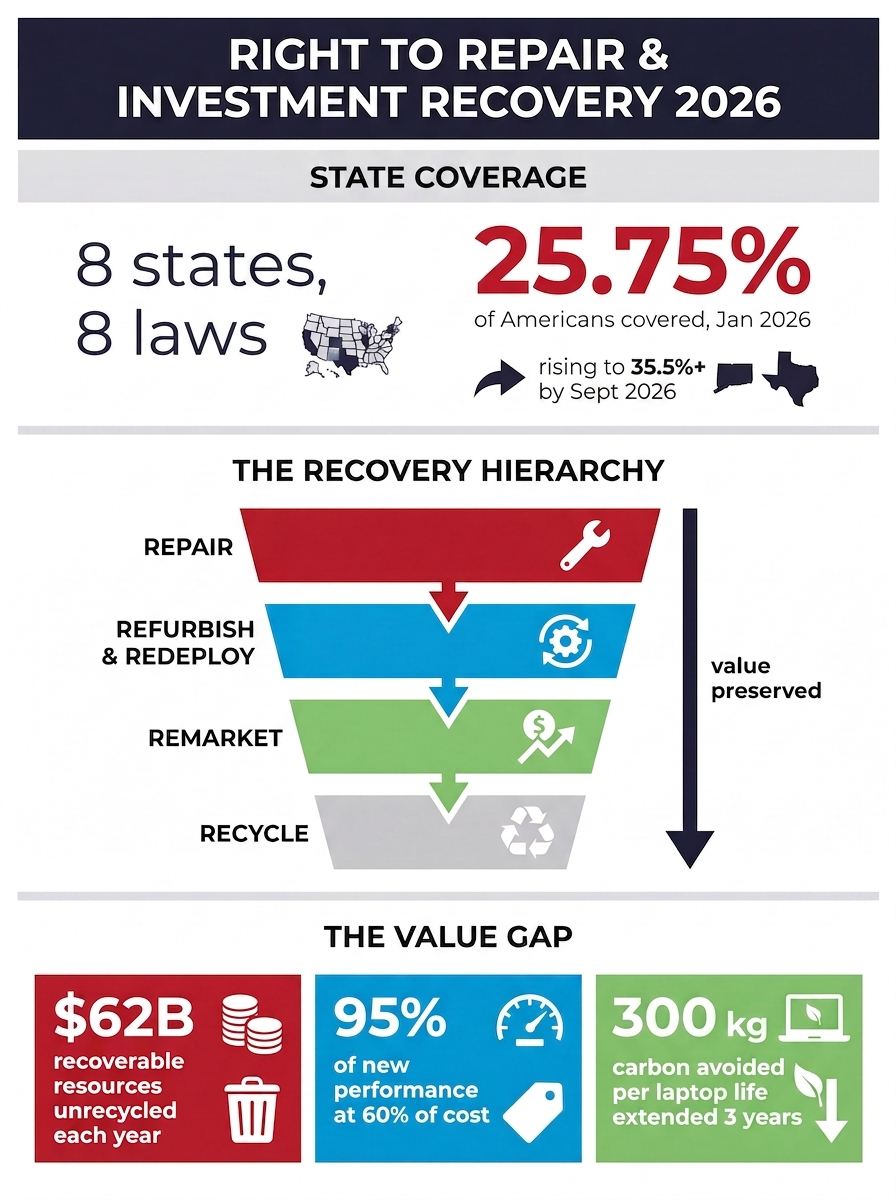
The 2026 right to repair value picture: more covered population, a clear recovery hierarchy, and a large e-waste value gap waiting to be captured.
Frequently Asked Questions
Sources and References
- U.S. PIRG, “More than one-quarter of Americans covered by Right to Repair come Jan. 1,” 2025. Supports coverage percentages and enacted-state count. pirg.org
- Waste Dive, “Right-to-repair bills make a comeback in 2026,” 2026. Supports the volume of new bills and legislative momentum. wastedive.com
- Morgan Lewis, “Navigating the Right to Repair Landscape in 2026,” 2026. Supports legal requirements and compliance context. morganlewis.com
- UNITAR / ITU, “Global E-waste Monitor 2024,” 2024. Supports e-waste tonnage, recycling rate, and recoverable resource value figures. unitar.org
- Grand View Research, “IT Asset Disposition Market Size & Share Report, 2026-2033,” 2025. Supports ITAD market size and growth. grandviewresearch.com
- 360 Market Updates, “IT Asset Reuse Market Share & Trends,” 2025. Supports IT asset reuse market size and refurbishment performance and cost figures. 360marketupdates.com
Disclaimer: This article is published by the Investment Recovery Association (IRA) for educational and informational purposes only. It does not constitute legal, financial, or professional advice. Market data, statistics, and projections cited are sourced from third-party reports and are subject to change. Readers should consult qualified professionals before making business decisions based on the information presented. The IRA makes no warranties regarding the accuracy or completeness of third-party data referenced herein.