TL;DR
- The digital product passport is a machine-readable record of what an asset is made of, how it was built, and what has happened to it since. The EU Central DPP Registry went live on 19 July 2026, and the first binding sector rule, the battery passport, lands on 18 February 2027.
- For investment recovery teams, this is not a compliance chore. It is the first time the data that determines resale value will arrive with the asset instead of being reconstructed from memory, spreadsheets, and guesswork.
- Used equipment trades at a discount largely because buyers cannot verify condition, materials, or service history. A passport removes that uncertainty, and analysts at Bain estimate that capturing post-sale and resale value can double a product’s lifetime value.
- North American companies are in scope whenever a covered product is placed on the EU market, and US state law is converging on the same data through right-to-repair, battery, and electronics EPR rules that took effect in 2026.
- The practical move for 2026 is a 90-day readiness plan: inventory the asset data you already hold, fix identifiers and chain of custody, then wire passport data into your disposition workflow before your first covered asset hits end of life.
A digital product passport is about to change how surplus assets are priced, and most investment recovery teams have never been asked for an opinion on it. The conversation so far has belonged to compliance departments, product designers, and ESG consultants. That is a mistake. The passport is a structured record of an asset’s identity, materials, and history, and those three things determine whether a retired chiller, a decommissioned battery rack, or a pallet of servers sells for eighty cents on the dollar or eight.
The timing is no longer theoretical. On 19 July 2026, the EU’s Ecodesign for Sustainable Products Regulation reaches full application, and the Commission’s Central DPP Registry is scheduled to go live. On 18 February 2027, the first mandatory passport requirement bites, covering industrial batteries above 2 kWh, EV batteries, and light means of transport batteries. Steel, textiles, furniture, and electronics follow through delegated acts running to 2030.
What a Digital Product Passport Actually Is, and Why Recovery Teams Should Care
A machine-readable record that travels with the asset
Strip away the regulatory language and a passport is simple: a unique identifier on the physical item, usually a QR code or an RFID tag, that resolves to a structured digital record. Scan the item, get the data. The record is hosted by the manufacturer or a service provider, and the EU registry stores only a pointer, the identifier and the URL, not the content itself.
What separates this from existing product documentation is that a passport is built to be read by machines and to persist for the life of the asset. A PDF datasheet filed in a shared drive dies with the person who filed it. A passport is queryable at the moment of disposition, by whoever holds the asset, which is exactly when recovery professionals need it.
Key distinction: The passport is not a database your company owns. It is a record attached to the product itself, which means it survives ownership changes. That is what makes it useful at end of life, and it is also what makes it a governance question rather than an IT project.
What data does the passport carry?
The exact fields vary by product category and are set in each sector’s delegated act, but the recurring elements are consistent: unique product identifier, manufacturer and supply chain operator identifiers, material and substance composition, recycled content share, durability and performance data, repairability information and spare parts availability, dismantling and recycling instructions, applicable certifications, and a lifecycle event log covering repair, refurbishment, resale, and recycling.
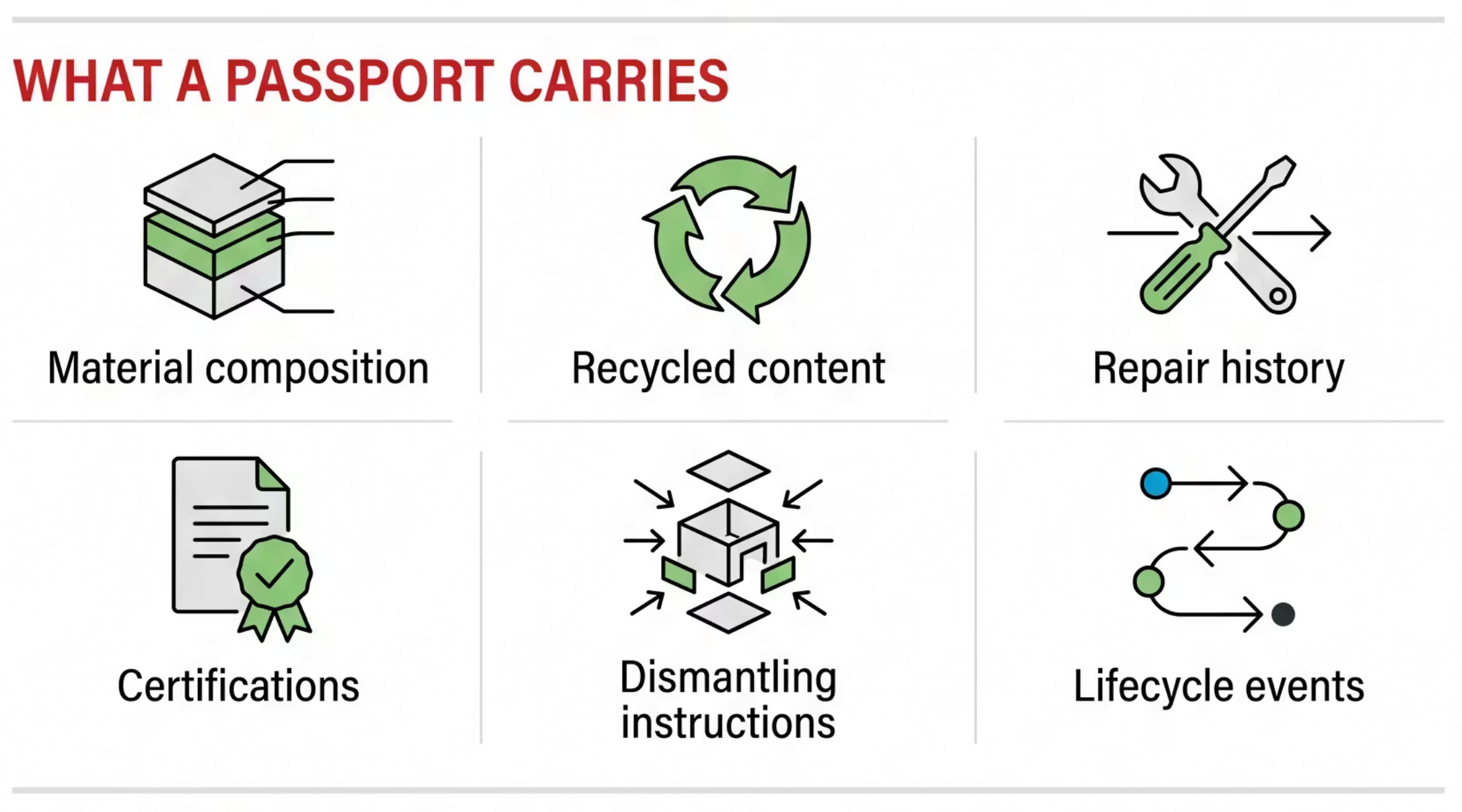
What a digital product passport carries, read with a disposition mindset.
Read that list again with a disposition mindset. Material composition is a scrap valuation input. Recycled content is an ESG reporting input. Repairability and spare parts availability determine whether refurbishment is viable. Dismantling instructions cut teardown labor. Certifications reduce buyer due diligence. The lifecycle event log is the condition report that surplus buyers currently have to take on trust.
Why disposition, not just compliance, has a stake
Most organizations will treat the passport as a manufacturing obligation and stop there. If your organization buys covered products, you become a passport consumer, and the data you inherit is free working capital for the recovery function. If your organization manufactures them, the passport you publish follows your equipment into the secondary market and shapes what buyers pay for it years later.
Investment recovery has always been an information business disguised as a logistics business. Our guide to what investment recovery is and how the discipline works returns to the same theme: the money is made or lost long before the asset reaches the auction floor. The teams that plan for passports now will be quoting from data while their peers are still quoting from memory.
The Deadlines That Actually Bind: 2026 Through 2030
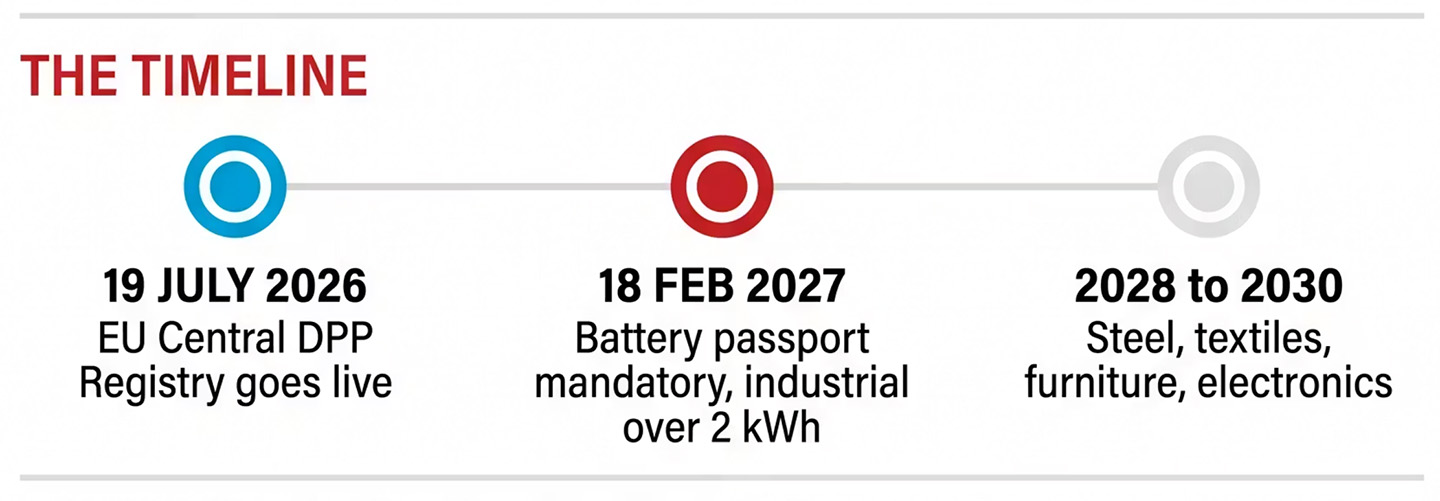
The digital product passport timeline, from infrastructure in 2026 to sector obligations through 2030.
19 July 2026: ESPR full application and the EU Central DPP Registry
The Ecodesign for Sustainable Products Regulation, Regulation (EU) 2024/1781, entered into full application on 19 July 2026, and the Commission’s Central DPP Registry is scheduled to open on the same day. Be precise about what this date does and does not mean, because the market is full of overstatement.
It is an infrastructure deadline on the European Commission, not a date by which every manufacturer must have registered every product. What changes is that the plumbing exists: the registry that holds unique identifiers, passport URLs, and metadata for customs and market surveillance authorities becomes operational, and DPP service providers must be able to integrate with it.
ESPR reaches full application and the EU Central DPP Registry goes live. Infrastructure first, sector obligations follow.
18 February 2027: the battery passport becomes mandatory
The first hard obligation arrives under the EU Battery Regulation. From 18 February 2027, industrial batteries above 2 kWh, electric vehicle batteries, and light means of transport batteries placed on the EU market must carry a battery passport with defined content, including carbon footprint, recycled content, state of health, and end-of-life handling information.
This is the deadline recovery professionals should mark. Our playbooks on EV battery recycling and second-life recovery and BESS decommissioning come back to the same bottleneck: without verified state-of-health data, a battery that could have been remarketed for a second-life application gets shredded for materials at a fraction of its value. The battery passport is the regulatory answer to that exact problem.
Steel, textiles, furniture, and electronics: the rolling delegated acts
The ESPR Working Plan for 2025 to 2030, adopted in April 2025, sets the sequence. Iron and steel are targeted for delegated act adoption in 2026, textiles in 2027, and furniture in 2028, with electronics and other categories behind them. Each delegated act typically allows roughly 18 months before compliance is required, pushing effective dates into 2028 and 2029.
| Milestone | Date | What it means for recovery teams |
|---|---|---|
| ESPR full application, EU Central DPP Registry live | 19 July 2026 | Infrastructure exists. Start asking vendors whether their passport data will be accessible to downstream holders. |
| Battery passport mandatory (industrial >2 kWh, EV, LMT) | 18 February 2027 | State-of-health and chemistry data becomes standard. Second-life resale gets materially easier to underwrite. |
| Iron and steel delegated act | Adoption targeted 2026 | Grade and recycled-content data on structural surplus improves scrap and reuse pricing. |
| Textiles delegated act | Expected 2027 | Relevant to uniform, PPE, and facility textile disposal programs. |
| Furniture, electronics, and later categories | 2028 to 2030 | The long tail. Most corporate surplus categories eventually land here. |
The honest read: if you dispose of batteries, you have a 2027 problem. If you dispose of steel and heavy industrial surplus, you have a 2027 or 2028 problem. If you dispose of IT equipment, your timeline is later, but your suppliers will publish passport data long before they are forced to, because their customers will demand it.
How the Digital Product Passport Changes Surplus Asset Valuation
Provenance closes the information gap that discounts used equipment
Every secondary market has the same defect. The seller knows more about the asset than the buyer, the buyer knows this, and so the buyer bids as if the asset were below average. That is the discount you eat because you cannot prove what you are selling.
The digital product passport attacks that defect directly. When a buyer can scan an asset and see verified material composition, manufacture date, service events, replaced components, and certification status, the risk premium collapses. Bain research concludes that when post-sale and resale opportunities are properly accounted for, the lifetime value of a product can double, and a single transaction can become a stream of ongoing revenue rather than a one-time sale.
The sustainability dividend: Reuse beats recycling on both financial and environmental grounds, every time. A passport that makes reuse credible pushes assets up the hierarchy, which is the same mechanism that drives the Scope 3 reductions covered in our 2026 ESG playbook for surplus assets.
Repair and refurbishment history becomes a pricing input
Today, a refurbished asset is worth what the refurbisher’s reputation says it is worth. The work itself is invisible. A passport that logs repair and refurbishment events changes that: the asset carries proof of the work, so the value added by refurbishment can be priced rather than assumed away.
A laptop with a documented battery replacement and a verified data-sanitization event is fundamentally different from an identical-looking laptop with no record, even though the two often sell at the same price today. The same logic runs through industrial rotating equipment, medical devices, and the semiconductor tools discussed in our analysis of the used semiconductor equipment market, where provenance already commands a premium.
What buyers guess today versus what a passport proves
| Valuation question | How it is answered today | How a passport answers it |
|---|---|---|
| What is it made of? | Assay, teardown, or an educated guess from the model number | Declared material and substance composition, including recycled content |
| How hard was it used? | Seller attestation, runtime hours if you are lucky | Lifecycle event log, performance and durability data |
| Can it be repaired or upgraded? | Call the OEM and wait | Repairability score, spare parts availability, service documentation |
| Is it compliant and safe to resell? | Paper certificates, if they were retained | Linked certifications and substance declarations |
| What is the environmental story? | Reconstructed after the fact for the ESG report | Carbon footprint and recycled content, reportable at source |
North American Companies Are In Scope Without an EU Address
The market-placement trigger
The obligation attaches to placing a covered product on the EU market, not to where the company is headquartered. A US manufacturer exporting industrial batteries to Europe is in scope. A US firm selling through a European distributor is in scope through that distributor, who will pass the data requirement upstream. And a US company that buys European-made equipment inherits passports whether it asked for them or not.
Passport data will show up in your asset base regardless of your regulatory posture. The question is not whether you will encounter passports. It is whether you will be organized enough to use them when you do.
Where US state law is converging on the same data
There is no federal EPR framework in the United States and no US passport statute. But the direction of travel is unmistakable. Electronics EPR laws now exist in roughly 25 states. Right-to-repair laws in Colorado, Nevada, Oregon, and Washington took effect in January 2026, covering most devices made or sold after 2021 and banning parts pairing. California expanded its e-waste program to more battery-embedded products, and Vermont broadened its battery EPR program.
Every one of those regimes needs the same underlying facts: what is in the product, how it can be repaired, and who is responsible for it at end of life. A company that builds a passport-ready data layer for the EU is most of the way to satisfying the US patchwork too. Readers of our 2026 investment recovery trends analysis will recognize the pattern: regulatory fragmentation raises the value of a single, well-governed asset data set.
Downstream effects on ITAD partners and resale channels
Your disposition partners will feel this before you do. An ITAD vendor that can ingest passport data, append its own sanitization and refurbishment events, and hand a complete record to the next buyer is selling a better product than one that cannot. Expect passport handling to become a line item in ITAD scoring, alongside the certification questions covered in our comparison of R2v3 and e-Stewards and the process fundamentals in the complete ITAD guide.
Procurement note: The cheapest place to fix your passport readiness is in the purchase contract, not at end of life. Add a clause requiring the supplier to provide passport data and to keep it accessible to downstream holders. Recovery teams rarely get a seat at the procurement table. This is a good reason to ask for one.
A 90-Day Digital Product Passport Readiness Plan for Investment Recovery
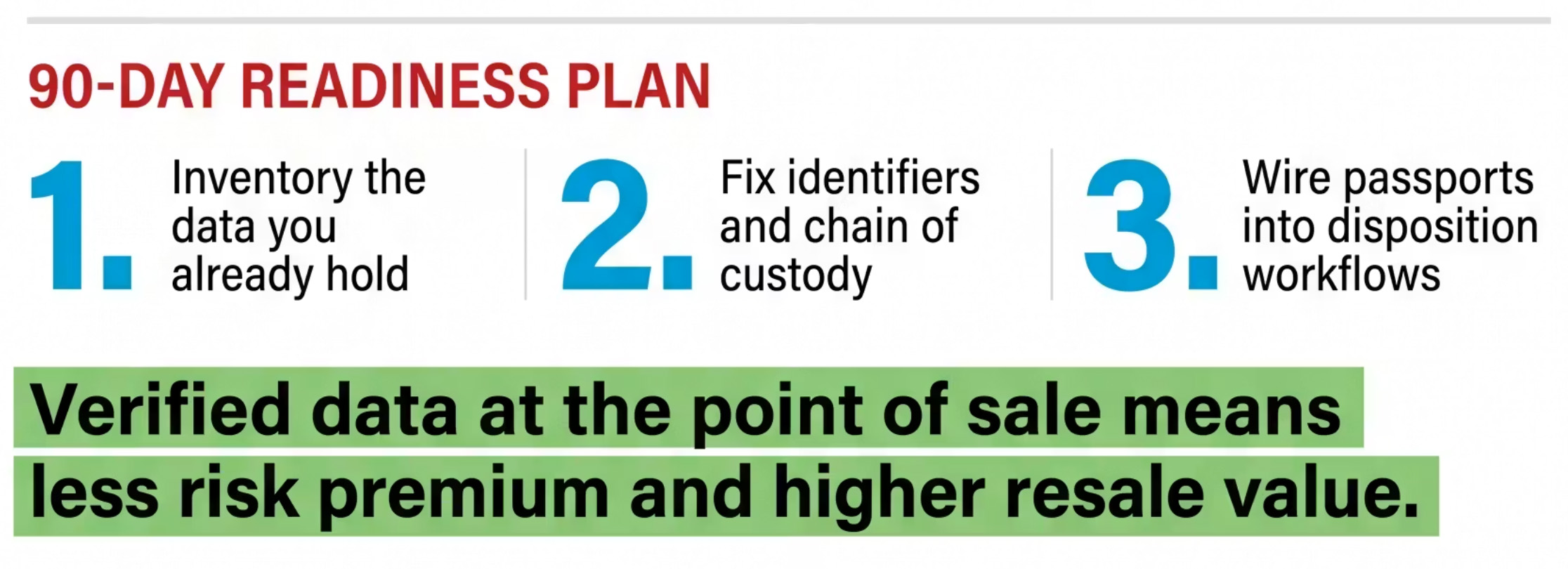
A 90-day plan to get investment recovery passport-ready without buying a platform.
You do not need to purchase a platform to start. You need to know what you hold, how you identify it, and where the data goes when the asset leaves.
Days 1 to 30: inventory the data you already hold
Pick your three highest-value disposition categories from the last twelve months. For each, list every data field a buyer asked for and every field you could not answer. That gap list is your requirements document, and it beats any vendor’s feature matrix. Then find where the data lives: usually scattered across the ERP asset master, CMMS records, warranty files, and the memory of one or two long-tenured engineers. Mapping it almost always reveals that you already hold most of what a passport would carry, just not in a form anyone can use at the point of sale.
Days 31 to 60: fix identifiers and the chain of custody
A passport is worthless without a stable unique identifier. If asset tags are inconsistent, if serial numbers get re-keyed at each system boundary, or if assets lose their identity when they reach the surplus yard, fix that first. It is unglamorous work and the highest-return step in the program. Then decide who is accountable for recording lifecycle events, because a repair that no one logs is a repair that never happened as far as the next buyer is concerned. The discipline is the same one described in our guide to circular economy asset management.
Days 61 to 90: wire passport data into disposition workflows
Change the disposition intake form. Every asset entering the pipeline should have a passport identifier field, present or absent. Where a passport exists, pull the data into the listing. Where it does not, record what you know in the same schema, so you are not rebuilding the process later. Then rewrite two documents: the surplus listing template, which should surface material composition, service history, and certifications in a standard block rather than free-text notes, and the ITAD and auction partner brief, which should require partners to accept and return passport data. Teams running structured processes for equipment liquidation and asset disposition already have both. This is an edit, not a rebuild.
Risks, Gaps, and What to Watch Next
Data quality and the garbage-in problem
A passport is only as trustworthy as the data it contains. Nothing guarantees that a manufacturer’s declared recycled-content figure is accurate, and self-declaration without verification invites greenwashing. Expect the first generation of passports to carry errors, omissions, and optimistic rounding. Treat passport data as a strong prior, not as gospel, and keep your own verification steps for high-value assets.
Who updates the passport after the first sale?
This is the open question that matters most to recovery professionals, and the regulation does not fully answer it. If a refurbisher replaces a component, who has the right and obligation to record that event in the passport? If the manufacturer hosts the record, does it have any incentive to log third-party repairs that extend the life of a product it would rather replace? Right-to-repair and the passport framework point in the same direction, but write access across the ownership chain is still being worked out.
Interoperability, vendor lock-in, and the cost question
A crowded market of DPP service providers is forming and not all of them will survive. Standards work through CEN and CENELEC is ongoing, and until it settles, choosing a platform means accepting migration risk. The sensible posture in 2026 is to invest in the data, which is portable, and defer commitment to any single platform, which is not. Keep your asset data in an open schema you control, and let the providers compete for the right to publish it.
The bottom line: The digital product passport does not create value on its own. It removes the friction that has always suppressed the value of used assets. Organizations that have already built strong recovery programs, of the kind described in our work on sustainable asset management and urban mining, will capture most of that upside. Organizations that have not will watch the data arrive and do nothing with it.
Frequently Asked Questions
What is a digital product passport in plain terms?
It is a structured digital record, accessible via a QR code or tag on the product itself, that describes what the item is made of, how it was made, how it can be repaired or recycled, and what has happened to it throughout its life. It is mandated in the EU under the Ecodesign for Sustainable Products Regulation and is designed to be read by machines, not just by people.
Does a digital product passport apply to used and refurbished equipment?
The passport is created when a product is first placed on the market and is intended to accompany the item through resale, repair, and refurbishment. That is the whole point of the design. The practical details of who may write new lifecycle events into a passport after the first sale are still being settled, and it is one of the most important open questions for the secondary market.
Do US companies need to comply with the EU digital product passport rules?
If a covered product is placed on the EU market, the obligation applies regardless of where the company is based. Even companies with no EU sales will encounter passports on equipment they buy from European suppliers, and US state-level right-to-repair, battery, and electronics EPR laws are converging on similar data requirements.
What happened in July 2026?
The Ecodesign for Sustainable Products Regulation reached full application, and the EU Central DPP Registry went live. This is an infrastructure milestone on the Commission, not a compliance cliff for manufacturers. Product-level obligations will be introduced sector by sector through delegated acts, starting with batteries on 18 February 2027.
How does a digital product passport affect the resale value of surplus assets?
Used assets trade at a discount because buyers cannot verify condition, composition, or service history and price that uncertainty into their bids. A passport provides verified data at the time of sale, which reduces the risk premium and supports reuse over recycling. Analysts at Bain estimate that fully capturing post-sale and resale value can double a product’s lifetime value.
Sources and References
- European Commission, Internal Market, Industry, Entrepreneurship and SMEs, The DPP Registry, 2026. Primary source on the Central DPP Registry and its role under ESPR Article 13.
- Regulation (EU) 2024/1781, Ecodesign for Sustainable Products Regulation (ESPR). Establishes the digital product passport framework and the delegated act mechanism.
- Regulation (EU) 2023/1542, EU Batteries Regulation. Sets the 18 February 2027 battery passport requirement for industrial batteries above 2 kWh, EV batteries, and LMT batteries.
- European Commission, ESPR Working Plan 2025 to 2030, adopted April 2025. Source for the sector sequencing of iron and steel, textiles, furniture, and later categories.
- Bain & Company, Digital Product Passports Introduce New Sources of Value. Source for the finding that post-sale and resale value capture can double a product’s lifetime value.
- Publications Office of the European Union, The EU’s Digital Product Passport: Advancing Transparency and Sustainability. Background on passport objectives and data scope.
- Waste Dive, Where new 2026 recycling and waste laws are taking effect. Source for 2026 US state right-to-repair, battery, and electronics EPR changes.
- National Conference of State Legislatures, Extended Producer Responsibility. Source for the count of US states with electronics EPR programs.
Disclaimer: This article is published by the Investment Recovery Association (IRA) for educational and informational purposes only. It does not constitute legal, financial, or professional advice. Market data, statistics, and projections cited are sourced from third-party reports and are subject to change. Readers should consult qualified professionals before making business decisions based on the information presented. The IRA makes no warranties regarding the accuracy or completeness of third-party data referenced herein.