
TL;DR
- A complete data center decommissioning checklist spans five phases: planning, security, physical removal, value recovery, and closeout reporting.
- The data center decommissioning services market reached $12.95 billion in 2026 and is projected to hit $19.94 billion by 2032 at a 7.37% CAGR.
- NIST SP 800-88 Revision 2 (published September 2025) replaces older sanitization techniques with IEEE 2883-2022 methods, requiring detailed certificates of sanitization with serial numbers, methodology, and verification results.
- The remarketing segment is the fastest-growing slice of ITAD at 10.5% CAGR, driven by residual GPU, CPU, and high-capacity memory value.
- Treating decommissioning as an investment recovery project (not a disposal job) routinely offsets 40 to 70 percent of project cost through resale and material recovery.
Why a Data Center Decommissioning Checklist Matters in 2026
A data center decommissioning checklist is the difference between a clean shutdown and a multi-million dollar liability. AI hardware refresh cycles have collapsed from five to seven years down to 18 to 36 months, and that pace is forcing enterprises and hyperscalers into continuous decommissioning instead of one-off events. The global data center decommissioning services market expanded from $12.12 billion in 2025 to $12.95 billion in 2026, and is projected to reach $19.94 billion by 2032 at a 7.37% compound annual growth rate. That volume is putting pressure on every team that owns a server room or cage, and the teams without a documented checklist are the ones generating headlines about lost data, missed value, and stalled real estate transactions.
Investment recovery professionals know the upside. Decommissioning done right can offset a substantial portion of project cost through resale, material recovery, and lease buy-backs. For broader context on how this fits into the rest of your strategy, see our guide to asset disposition and our explainer on what investment recovery actually is. This article gives you the practical, phase-by-phase checklist you can hand to a project manager tomorrow.
2026 global data center decommissioning services market, growing to $19.94B by 2032
Phase 1: Pre-Project Planning and Asset Inventory
Every successful data center decommissioning checklist starts long before anything is unplugged. The planning phase is where security and value recovery either get built in or get bolted on as expensive afterthoughts. Skip this phase and you will discover unmapped dependencies, missing serial numbers, and surprise hazardous materials at the worst possible moment.
Building a Cross-Functional Decommissioning Team
A data center is owned by infrastructure, but it is used by everyone. Your project team needs IT operations, information security, facilities, legal, finance, sustainability, and at least one investment recovery lead with authority to make resale decisions. Define a RACI matrix early. Who is responsible for the data destruction certificate? Who must be consulted on the asset resale floor price? Who has the final accountable signature for environmental disposal? Without these answers in writing, the project will stall the first time someone questions a decision.
Auditing Every Asset (Hardware, Software, Cabling)
The asset inventory is the spine of the entire data center decommissioning checklist. Walk every rack and capture: asset tag, serial number, manufacturer, model, original purchase date, depreciation status, configuration (CPU, RAM, storage, GPUs), software licenses, and current operational status. Reconcile against your CMDB and your finance fixed-asset register. Variances are normal. Investigate them anyway. Cabling, racks, PDUs, cooling units, fire suppression hardware, raised flooring, and structured cabling all carry residual value and must be on the same inventory.
Risk Assessment and Stakeholder Sign-Off
Before a single cable is pulled, document the risks: data exposure, regulatory exposure (HIPAA, PCI-DSS, GDPR, SOC 2, FedRAMP), business continuity, environmental liability, and reputational exposure. Map each risk to a mitigation in the data center decommissioning checklist. Then route the entire plan to executive sponsors for written sign-off. This is the single most underused control in the industry. Sign-off creates accountability, accelerates issue escalation, and protects the project owner if something goes wrong later.
Planning Tip: Build your data center asset disposition strategy into Phase 1. Knowing in advance which assets will be remarketed, which will be recycled, and which will be destroyed shapes every later decision, from logistics scheduling to insurance coverage.
Phase 2: Data Center Decommissioning Best Practices for Security
Security is the highest-stakes part of any data center decommissioning checklist. A single drive that escapes the chain of custody can trigger breach reporting, regulatory penalties, and class-action litigation that dwarfs whatever value you recovered from the project. The 2026 standard for security in decommissioning has been redrawn by the September 2025 publication of NIST SP 800-88 Revision 2.
NIST 800-88r2 Sanitization Methods (Clear, Purge, Destroy)
NIST 800-88 has been the de facto media sanitization standard for over a decade. Revision 2, published in September 2025, modernizes it for SSDs, NVMe drives, GPUs with onboard memory, and modern storage controllers. The biggest change: NIST SP 800-88r2 removes its own sanitization technique appendices and instructs organizations to follow IEEE 2883-2022 for approved sanitization processes. The familiar three-tier model still applies: Clear (logical overwrite for low-risk reuse), Purge (cryptographic erase, block-level overwrite, or media-specific firmware purge for higher assurance), and Destroy (physical disintegration, melting, or incineration for the highest assurance). Degaussing, which was effective for spinning disks, is useless for SSDs and flash storage. Modern compliance requires cryptographic erasure, block-level overwrite, or physical destruction through disintegration for flash-based media.
Chain of Custody Documentation
Chain of custody is a paper trail (increasingly a digital trail) that tracks every storage device from the moment it is removed from a server to the moment it is sanitized or destroyed. Each handoff must be logged with timestamp, location, custodian name, and asset serial number. Use barcode or RFID scanning at every transition. Photograph hard drives before and after destruction. Maintain a tamper-evident manifest. If your secure data destruction vendor cannot provide a real-time chain of custody portal, find a different vendor. For more on selecting credible vendors, see our comparison of R2v3 vs. e-Stewards ITAD certifications.
Certificate of Destruction Requirements
The certificate of destruction is the auditable proof that closes the loop. NIST 800-88r2 tightened the documentation requirements: organizations must maintain detailed certificates of sanitization that include device serial numbers, sanitization methodology, tool versions, and verification results. Generic “we destroyed your stuff” letters no longer meet the standard. For each drive or asset, the certificate should record the sanitization method used, the date, the operator, the verification step, and the witness. Store these certificates for the longer of (a) your records retention policy or (b) seven years after the asset’s original purchase date.
Sustainability Note: Cryptographic erase and certified data wipe preserve the asset for resale or donation, while physical destruction limits options to material recycling. Building secure data destruction methods into your data center decommissioning checklist directly affects how much you can divert from landfill and how much value you recover.
Phase 3: Server Decommissioning Process and Physical Removal
The server decommissioning process is where careful planning meets physical reality. This phase has the most moving parts, the highest worker safety risk, and the most exposure to value loss through mishandling. A solid server decommissioning checklist for this phase should drive sequencing, logistics, and environmental safety in parallel.
Power Down Sequencing and Network Disconnection
Servers must be powered down in a documented sequence that preserves dependent applications until they have been migrated or formally retired. Use change control. Disconnect networking with the network team present. Label every cable as it is pulled so it can be inventoried. Power down PDUs only after all loads are confirmed off. Treat each rack as a unit and confirm the rack is fully powered down before moving to the next. Rushed power-downs are how spinning disks die mid-write, taking forensic recoverability with them.
Tagging, Crating, and Logistics
Once an asset is powered down and disconnected, it gets a removal tag with the same asset ID from the inventory. Crate by destination: assets going to the remarketing channel should not share a pallet with assets going to physical destruction. Photograph crated pallets before they leave the facility. Use bonded carriers for any equipment carrying storage media. GPS-tracked vehicles are now a baseline expectation for sensitive workloads. Confirm receipt at the next destination within 24 hours of pickup.
Environmental and Hazardous Material Handling
Data centers contain materials that trigger federal and state environmental rules: lithium-ion batteries in UPS systems, lead in older battery banks, mercury in some lamps, refrigerants in cooling systems, and brominated flame retardants in plastics. Each must be handled by a licensed transporter and disposed of through a permitted facility. Maintain a manifest for every shipment. Sign and retain the disposal facility’s certificate of destruction. For broader sustainability framing, see our piece on circular economy asset management and our guide to ESG-compliant asset lifecycle management.
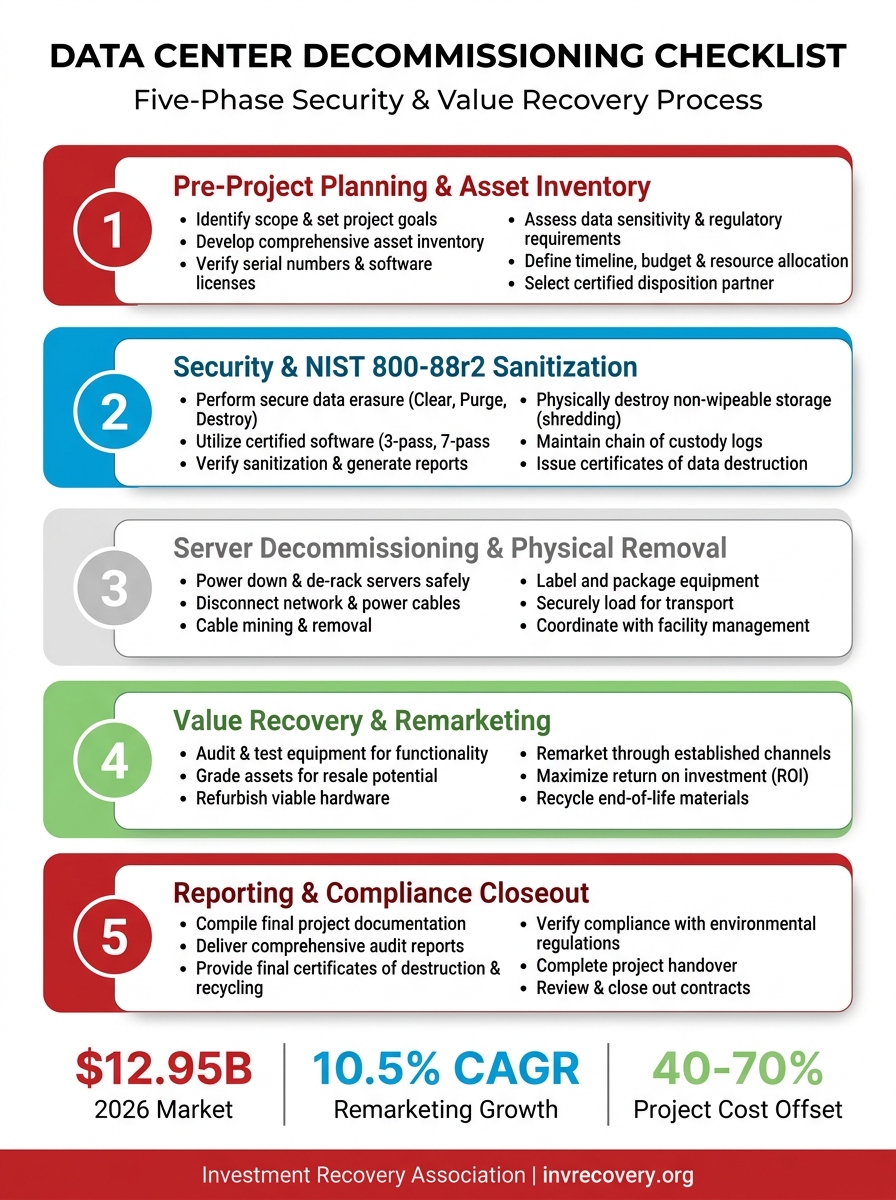
Five-phase data center decommissioning checklist with security, value recovery, and sustainability checkpoints.
Phase 4: Data Center Value Recovery and Remarketing
Value recovery is the phase where investment recovery professionals earn their seat at the table. Done well, this phase can offset 40 to 70 percent of total decommissioning project cost, sometimes more for facilities heavy in late-model GPUs and high-capacity memory. The remarketing segment is the fastest-growing slice of the ITAD market, projected to grow at a 10.5% CAGR between 2026 and 2035, driven by corporate appetite for circular economy outcomes and the strong residual value of AI-era hardware.
Quantifying Resale Value Before Removal
Get a written valuation before you commit to a removal date. The secondary market for AI and high-density compute equipment moves fast, and a delay of 90 days can cost 15 to 30 percent of resale value. Pull live secondary-market quotes from multiple sources. Consider lot-pricing versus piece-pricing. Factor in the cost of cleaning, certifying, and warranty-attaching used equipment. Build the floor price into your project budget so the project manager has clear go/no-go thresholds. Our overview on equipment liquidation ROI walks through the financial mechanics in detail.
Choosing a Remarketing Channel
The remarketing channel determines both the speed and the realized value of data center value recovery. Direct sale to an end user (often via brokers or platforms) typically yields the highest dollar return but takes the longest. Sale to an ITAD reseller is faster but at a discount. Online auction can be a middle ground for high-volume, mixed-quality lots. Consignment offers upside but ties up cash. For mission-critical timelines, blended strategies usually win. To put structure around your sourcing decision, see our tech-driven strategies for surplus asset recovery and asset recovery services overview.
Recycling and Component Harvesting for Stranded Assets
Not every asset will be remarketed. Equipment that fails functional testing, that sits below the floor price, or that is mandated for destruction goes through certified recycling. Component harvesting is an underused middle path: drives can be destroyed while RAM, NICs, power supplies, and chassis are harvested for resale or warranty pools. Use only certified recyclers (R2v3 or e-Stewards). For deeper context on the broader trend, see our e-waste and ITAD trends playbook.
| Channel | Typical Recovery | Speed | Best For |
|---|---|---|---|
| Direct end-user sale | 70 to 90% of fair market | 60 to 180 days | Late-model GPUs, high-end servers |
| ITAD reseller buyout | 35 to 60% of fair market | 14 to 45 days | Mixed lots, tight timelines |
| Online auction | 40 to 70% of fair market | 21 to 60 days | Mid-tier servers, networking |
| Component harvest + recycle | 5 to 20% of fair market | 30 to 60 days | End-of-life or destroyed assets |
Phase 5: Post-Project Reporting and Compliance Closeout
The data center decommissioning checklist is not finished when the last truck leaves. Post-project reporting is what protects the organization in audits, what informs the next project, and what proves the value the IR team delivered.
Final Reconciliation Reports
Reconcile the closing inventory against the opening inventory. Every asset must have a documented disposition: remarketed (with sale price and buyer), recycled (with weight, vendor, and material categories), donated (with recipient and tax valuation), or destroyed (with certificate). Variances must be investigated and resolved before the project closes. Send the reconciliation to finance, legal, infosec, and the executive sponsor. This is also the deliverable that supports your IR team’s case for next year’s budget.
Sustainability Metrics: Carbon Diverted and Materials Recovered
Sustainability reporting has moved from optional to expected. Calculate kilograms diverted from landfill, embodied carbon avoided through reuse, and materials recovered by category (steel, aluminum, copper, plastics, precious metals). Investment recovery professionals are uniquely positioned to feed this data to corporate ESG reporting. Server decommissioning services that cannot supply these metrics are increasingly being replaced by vendors that can. Our sustainability wins for IR pros piece has examples of how leading programs report and amplify this data.
Lessons Learned for the Next Project
Capture what worked and what did not while the team’s memory is fresh. Common findings: undocumented dependencies, surprise hazardous materials, vendor performance issues, value forecasting errors, and missed certifications. Update your data center decommissioning checklist template with each project. Treat the checklist as a living document. The organizations that scale this discipline best treat each decommissioning project as practice for the next one. For broader IR program context, see our guide on sustaining and growing your IR program.
Building Your Data Center Decommissioning Checklist Template
The fastest way to get value from this article is to convert it into a working template. Capture each phase as a tab in a spreadsheet or a section in a project management tool. Inside each phase, list the discrete tasks, the owner, the deliverable, the deadline, and the verification step. Add a status column with a small set of values (not started, in progress, blocked, complete). Add a notes column for exceptions. Review the template after each project and prune what is not adding value. The best data center decommissioning checklist is the one your team actually uses.
If you need help benchmarking your current process, our IR program maturity assessment gives you a framework for self-evaluation. And to see how the broader market is evolving, our analysis of why AI is accelerating data center decommissioning cycles explains why getting this discipline right is becoming a competitive issue, not just an operational one.
Frequently Asked Questions
Sources and References
- National Institute of Standards and Technology, NIST SP 800-88 Revision 2: Guidelines for Media Sanitization, September 2025 — primary standard cited for sanitization methods and certificate of destruction requirements. Source
- IEEE, IEEE 2883-2022: Standard for Sanitizing Storage, 2022 — referenced by NIST 800-88r2 as the approved sanitization process. Source
- Fortune Business Insights, Data Center IT Asset Disposition Market Size, Share [2026-2034] — source for ITAD market size and growth projections. Source
- GlobeNewswire / The Business Research Company, Data Center Decommissioning Services: Global Market Trends and Growth Forecast 2026-2032, January 2026 — source for the $12.95B 2026 market size and 7.37% CAGR. Source
- Global Market Insights, IT Asset Disposition (ITAD) Market Size & Share 2026-2035 — source for the 10.5% remarketing segment CAGR. Source
- SK TES, What is NIST 800-88, and what is meant by Clear, Purge, and Destroy? — supporting reference for the Clear/Purge/Destroy sanitization model. Source
- Blancco, What is NIST 800-88, and What Does Media Sanitization Really Mean? — supporting reference for cryptographic erase and SSD sanitization methods. Source
- TechTarget, How to decommission a data center: A step-by-step guide — supporting reference for power-down sequencing and physical removal best practices. Source
This article is published by the Investment Recovery Association (IRA) for educational and informational purposes only. It does not constitute legal, financial, or professional advice. Market data, statistics, and projections cited are sourced from third-party reports and are subject to change. Readers should consult qualified professionals before making business decisions based on the information presented. The IRA makes no warranties regarding the accuracy or completeness of third-party data referenced herein.