
TL;DR
- Mature investment recovery services return more than $20 for every $1 invested, according to independent benchmarking cited by the Investment Recovery Association.
- On average, 10% of an organization’s capital equipment is surplus at any given time, representing millions in stranded value sitting on balance sheets.
- A minimum viable investment recovery program launches in 90 to 180 days with 1 to 2 dedicated owners, a written disposition policy, and a pilot business unit.
- The five launch steps are: build the business case, structure the team, define policies and channels, select technology, and pilot-then-scale with Year 1 KPIs.
- Professional credibility accelerates with CMIR certification and Investment Recovery Association membership, the only dedicated credentials in the field.
Why Now Is the Right Time to Launch Investment Recovery Services
Every organization carries hidden value on its balance sheet: idle machinery in a back lot, servers racked and powered in a decommissioned data hall, pallets of packaging stacked three rows deep in a warehouse, vehicles nobody has driven in a year. Formalized investment recovery services turn that stranded value into cash, redeployment credits, and measurable sustainability wins. According to Investment Recovery Association benchmarking, an effective program will find that roughly 10% of an organization’s capital equipment is surplus at any given time and that mature programs return more than $20 for every $1 invested in the function. This playbook walks through how to stand that program up in 180 days.
2026 is an especially urgent moment to formalize a program. Tariff volatility is pushing manufacturers to rethink surplus strategy under shifting trade policy. AI infrastructure upgrades are accelerating data center decommissioning cycles. And customer, investor, and regulator pressure around Scope 3 emissions is turning asset disposition from a back-office chore into a visible sustainability lever. Launching the function this year is both a financial and ESG decision.
Benchmark return of mature investment recovery programs per Investment Recovery Association research
What Is an Investment Recovery Program?
An investment recovery program is the formal corporate function that identifies, values, and disposes of surplus, idle, and retired assets to recover maximum financial, operational, and environmental value. It sits at the intersection of supply chain, finance, sustainability, and compliance. Where liquidation is a one-off event and ad-hoc surplus disposal is reactive, a real program runs continuously and is policy-driven. For a deeper primer on scope and vocabulary, see our guide on what investment recovery is in 2026.
Investment Recovery Services vs. Surplus Disposal vs. Asset Disposition
These terms get used loosely. Clear definitions matter because they shape policy, budget, and reporting.
| Term | Scope | Cadence |
|---|---|---|
| Investment recovery services | End-to-end program: identification, valuation, redeployment, resale, donation, recycling, reporting | Continuous, governed by policy |
| Asset disposition | The transactional step of moving an asset out of the enterprise to its next use or end of life | Event-level, inside the broader program |
| Surplus disposal | Often reactive, tactical clear-outs; may bypass valuation and policy | Ad hoc, project-driven |
| Liquidation | A channel, not a program — typically time-pressured bulk sale | Episodic |
For the transactional nuances of moving an asset out of the enterprise, see asset disposition explained.
The $20-to-$1 ROI Benchmark and How It Works
The headline number that justifies the program to a CFO is the $20-to-$1 benchmark. It reflects four stacked value streams: net recovery (gross proceeds minus fees and logistics), cost avoidance through internal redeployment, storage cost reduction (space, insurance, security, maintenance), and revenue pull-forward by freeing capital tied up in idle assets. Equipment redeployment alone saves 85% or more compared to buying new, which is why the highest-performing programs treat internal reuse as the first-choice channel.
Step 1 — Build the Business Case for Investment Recovery Services
Launching the function without an executive mandate is the single most common reason programs stall. The business case is the one artifact that unlocks the charter, the budget, and the cross-functional cooperation you will need from Finance, IT, EHS, Legal, and Operations.
Quantify Idle and Underutilized Assets Across the Enterprise
Start with a rough-cut surplus inventory. Pull fixed asset registers, ERP item masters, warehouse slotting reports, and data center capacity reports. Apply the 10% rule as a starting hypothesis: if your depreciated capital base is $500 million, assume $50 million in surplus until the data says otherwise. Visit three facilities unannounced and count pallets, racks, and yard equipment that have not moved in 90 days. That walkaround alone typically validates the case. For a structured diagnostic, run the IR program maturity assessment before the first pitch meeting.
Project Revenue, Cost Avoidance, and Sustainability Gains
Build a three-year pro forma that includes net recovery (use conservative 10% of original cost for heavy industrial assets, higher for IT), redeployment savings (model at 85% of new purchase price), holding cost avoidance (3 to 8% of asset value annually), and carbon avoided (use 20kg CO2e per kg of metal scrap reused as a conservative default, and refine once data is available). Present a base, target, and stretch case. Our detailed framework in how to build an investment recovery business plan that works walks through the assumptions.
Win Executive Sponsorship in One Pager
The executive one-pager should answer four questions in sixty seconds: How much surplus value is on our balance sheet? What is the three-year ROI? What are the risks of not launching? What is the ask? Close by naming the executive sponsor (usually CPO, CFO, or Chief Sustainability Officer) and the pilot business unit. Keep the ask small: a charter, a pilot budget, and access to two business units for the first six months.
Field tip: The fastest path to approval is pairing a financial win with a sustainability win. CSOs get Scope 3 credit; CFOs get P&L credit. A joint sponsorship is stickier than either one alone.
Step 2 — Structure Your Investment Recovery Program Team
The second most common reason these programs fail is a fuzzy operating model. Decide early where the function lives on the org chart and who makes what decisions.
Three Organizational Models: Centralized, Decentralized, Hybrid
Centralized concentrates decision rights and vendor relationships in a corporate team. Best for moderate to large enterprises with repeatable asset categories and a mandate for consistency. Decentralized leaves disposition decisions with business units, with the corporate team providing standards and tools. Best for highly diverse portfolios where local expertise matters. Hybrid (sometimes called federated or center-of-excellence) sets policy and handles high-risk or high-value assets centrally while pushing tactical execution to business units. Most Fortune 1000 programs land here. For deeper treatment including shared services and outsourced models, see how to create an investment recovery department.
Core Roles and Day-1 Staffing Plan
A minimum viable investment recovery program team looks like this on Day 1:
- IR Program Lead — accountable for P&L, policy, and stakeholder management; reports to CPO, CFO, or CSO.
- Disposition Specialist — owns channels (redeployment, auction, direct sale, donation, recycling) and vendor performance.
- Compliance & Data-Sanitization Owner — shared from IT and EHS initially; full-time as IT asset volume scales.
- Analyst — owns the asset master, valuation data, KPI reporting, and the maturity scorecard.
Most programs start with 1 to 2 dedicated full-time equivalents plus 0.5 FTE of shared Finance, IT, and EHS support. Scale headcount as volume and risk grow, not before.
Reporting Lines That Actually Work
The three reporting homes that produce the best outcomes are Chief Procurement Officer (leverages sourcing muscle and vendor governance), Chief Financial Officer (tightest link to the P&L, cleanest KPI attribution), and Chief Sustainability Officer (strongest for circular economy narratives and Scope 3 goals). Reporting to Facilities or Real Estate is a red flag; programs there tend to shrink into “garage sale” operations.
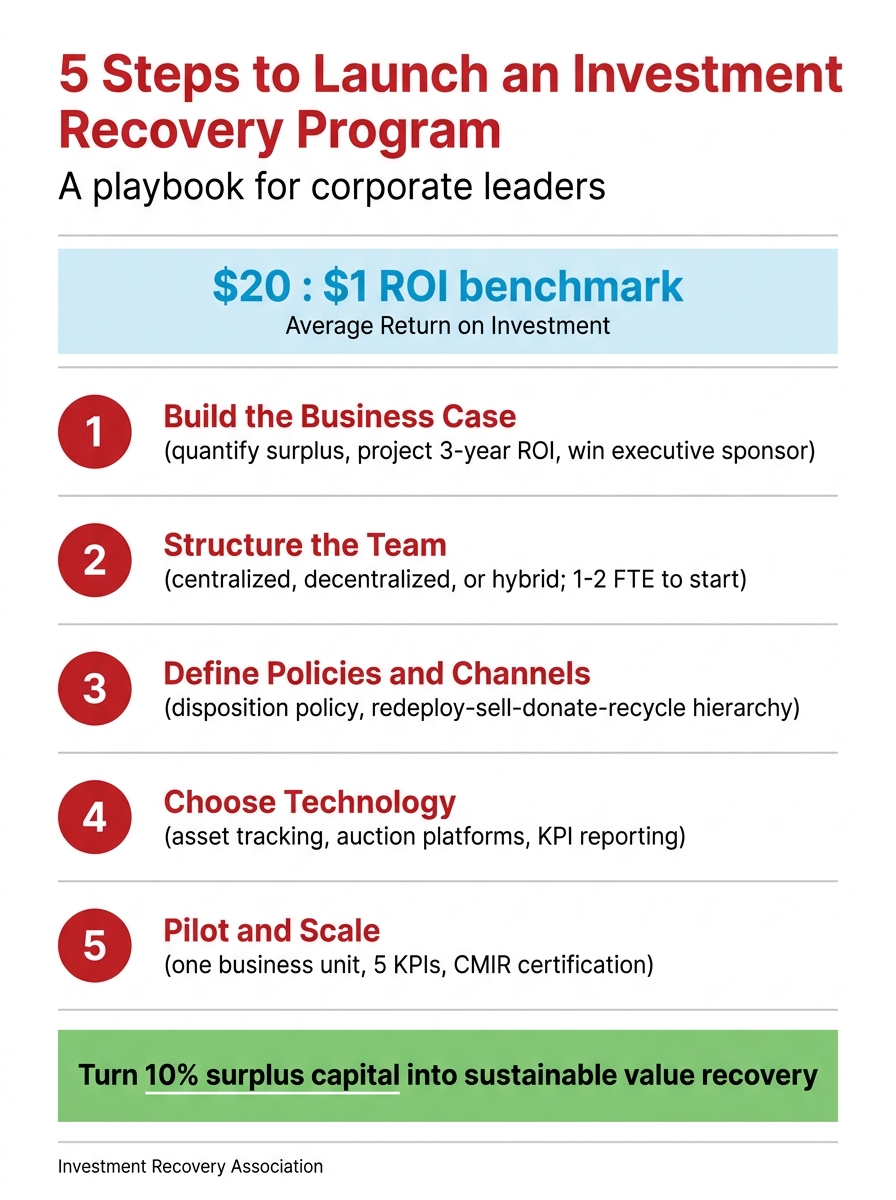
The 5 steps to launch investment recovery services at any organization, mapped to owners and Day-1 deliverables.
Step 3 — Define Policies, Workflows, and Disposition Channels
A written enterprise asset disposition policy is the operating backbone. Without it, you will rediscover the same shadow process in every business unit.
Write an Enterprise Asset Disposition Policy
The policy should define what qualifies as surplus, who has disposition authority at what dollar thresholds, which channels are approved, the minimum data required before an asset is listed, chain-of-custody requirements, and reporting obligations. Keep it under ten pages. Publish it as a procurement policy so it inherits existing governance.
Map Channels: Internal Reuse, Auction, Direct Sale, Donation, Recycle
Define the disposition decision tree in order of value-per-asset: internal redeployment first, negotiated sale to a known buyer second, public auction third, donation fourth, and responsible recycling last. Each channel needs an approved vendor list, a pricing rule (floor price, reserve logic), and a reporting template. For high-value industrial assets, see how to maximize ROI on equipment liquidation.
Integrate IT Asset Disposition (ITAD) for Electronics
IT assets are the fastest-growing category for most programs and carry the highest compliance risk. Treat IT asset disposition as a specialized channel with non-negotiable data-sanitization standards and certified downstream partners. The ITAD complete guide covers process and cost, and the deep dive on R2v3 vs. e-Stewards certification explains which certification to require from your downstream vendors.
Step 4 — Choose Technology to Run Investment Recovery Services
Technology is a force multiplier, not the program itself. The goal is to stop running the function on spreadsheets and email by month six.
Asset Tracking and Master Data
Most programs start by extending the existing fixed asset register or EAM/CMMS system with a “disposition status” field. Tag each asset with location, original cost, net book value, condition code, and last-move date. Do not buy a new system in year one; you will not know your real requirements yet.
Auction and Marketplace Platforms
Evaluate three or four approved platforms across industrial auctioneers, online marketplaces, and specialized brokers. Negotiate master services agreements with fee caps and performance SLAs. Concentrate volume with two preferred partners so you earn relationship rates while keeping a competitive check in place.
Reporting: Value Recovered, Avoided Landfill, Carbon Saved
Your dashboard should show three numbers, refreshed monthly: dollars of net value recovered, tons diverted from landfill, and metric tons of CO2e avoided. The carbon number is what aligns the program to circular economy asset management goals and Scope 3 reporting.
Sustainability win: Every ton of steel redeployed instead of remanufactured avoids roughly 1.4 tons of CO2e. An IR program is among the highest-leverage Scope 3 programs a company can run.
Step 5 — Launch, Measure, and Scale Your Investment Recovery Services
A good launch plan is deliberate, small, and visible. Pilot with one business unit, publish results, then expand.
Pilot One Business Unit Before Going Enterprise-Wide
Pick a business unit with a cooperative leader, a clear surplus problem, and an upcoming decommissioning event. A 120-day pilot should produce a quantified recovery number, a documented workflow, and a list of the top five friction points for the enterprise rollout. Resist the urge to go broad in year one; breadth without a repeatable playbook produces ad hoc auction-style events, not a program.
Year-1 KPIs Executives Care About
Track five KPIs. Net recovery dollars (absolute and against budget). Recovery rate (net proceeds divided by original cost or replacement value). Cycle time from surplus flag to completed disposition. Redeployment rate (the share of assets reused internally). Diversion rate (the share of total weight kept out of landfill). Measure and report them the way Finance does, with actual versus target and month-over-month trend.
Sustain Momentum with CMIR Certification and IRA Membership
The single biggest predictor of a program that survives leadership changes is professional credibility. Send your IR lead and disposition specialist through CMIR certification, the only dedicated investment recovery credential in the field. Join the Investment Recovery Association for peer benchmarks, the annual conference, and access to 2026 investment recovery trends research. Once the program is running cleanly, shift the playbook toward growth using the 8-step framework for sustaining and growing an IR program.
Frequently Asked Questions
Sources and References
- Investment Recovery Association, “What Is Investment Recovery? The Complete 2026 Guide” — benchmark that 10% of capital equipment is surplus at any given time, $20-to-$1 ROI benchmark.
- Investment Recovery Association, “How to Create an Investment Recovery Department: Organizational Models That Scale” (2026) — centralized, decentralized, and hybrid structural models.
- Investment Recovery Association, “Sustaining and Growing Your Investment Recovery Program: 8 Steps That Scale” — KPI framework (recovery value, cost avoidance, cycle time, redeployment, diversion).
- Ellen MacArthur Foundation (2025) — circular supply chain models reached a $375 billion global market segment; cited via Sustainability Atlas market map.
- Verdantix, “Rising Expectations For Sustainability In 2026: 10 ESG & Sustainability Predictions” — 35% of FTSE 250 publishing assurance opinions covering product sustainability claims in 2026.
- Liquidity Services, “Six Cross-Sector Trends That Maximize Surplus Asset Recovery Value” — redeployment savings of 85%+ versus new equipment purchase.
- REUZEit, “Circular Surplus Asset Management White Paper” — framework pairing surplus asset management with circular economy principles.
- Investment Recovery Association, “IR Program Maturity Assessment” — diagnostic framework for benchmarking investment recovery programs.
Disclaimer: This article is published by the Investment Recovery Association (IRA) for educational and informational purposes only. It does not constitute legal, financial, or professional advice. Market data, statistics, and projections cited are sourced from third-party reports and are subject to change. Readers should consult qualified professionals before making business decisions based on the information presented. The IRA makes no warranties regarding the accuracy or completeness of third-party data referenced herein.