TL;DR
- The UL 2799 standard defines zero waste to landfill as 90%+ diversion — and a new generation of technologies is making that target achievable and economically viable.
- Seven technologies are driving results: AI-powered sorting, advanced chemical recycling, anaerobic digestion, gasification, IoT smart waste management, industrial composting, and digital asset recovery marketplaces.
- The most successful programs layer multiple technologies in a deliberate hierarchy — reuse first, then recycle, compost, recover energy, and landfill only as a last resort.
- IR professionals are uniquely positioned to lead zero waste initiatives, with IRA members returning $20+ for every $1 invested at the highest maturity levels.
The 90% Threshold Is No Longer a Dream — It’s an Engineering Problem
For decades, “zero waste to landfill” sounded aspirational — the kind of goal that looked great in a sustainability report but remained frustratingly out of reach for most organizations. That is changing fast. A new generation of technologies is making 90%+ landfill diversion rates not just achievable, but repeatable and economically viable. For investment recovery professionals, these technologies aren’t just environmental wins — they’re tools that unlock new revenue streams, reduce disposal costs, and strengthen the business case for IR programs at the executive level.
The UL 2799 standard defines the benchmark: facilities achieving 90–94% diversion earn Silver certification, 95–99% earn Gold, and 100% diversion earns Platinum. Companies like AT&T have reported 98% landfill diversion rates through organized asset recovery programs, proving these numbers are real — not theoretical.
The scale of the challenge: Worldwide solid waste generation is projected to reach 3.4 billion metric tons by 2050 — a nearly 70% increase from current levels. With less than 20% of waste properly recycled today, the technologies in this article represent the critical bridge between where we are and where we need to be.
7 Technologies Achieving 90%+ Diversion
Each of these technologies addresses a different slice of the waste stream. The most successful zero-waste programs don’t rely on a single solution — they layer multiple technologies into an integrated diversion strategy that aligns with circular economy principles. Here’s what IR professionals need to know about each one.
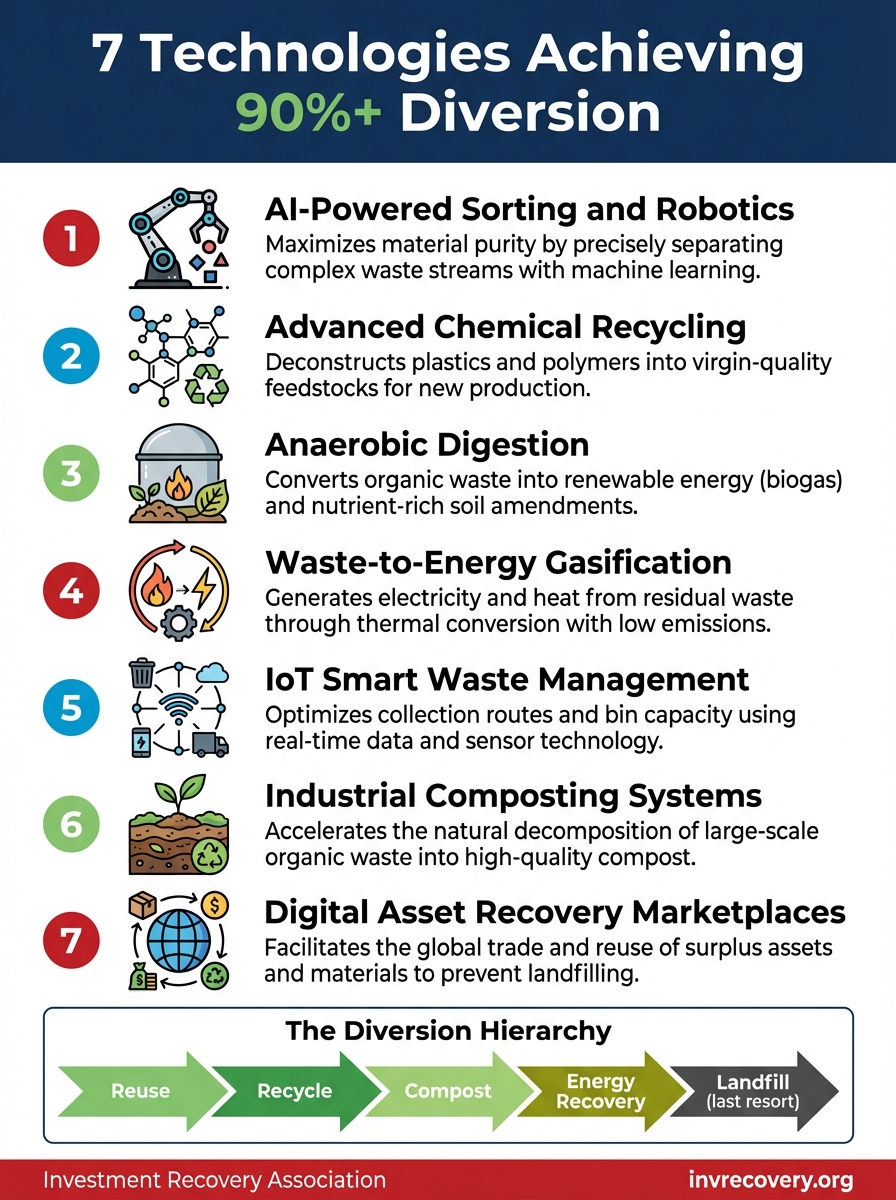
Seven technologies driving 90%+ landfill diversion — from AI sorting to asset recovery marketplaces.
1. AI-Powered Sorting and Robotics
Artificial intelligence has transformed material recovery facilities (MRFs) from labor-intensive operations into precision sorting systems. Modern AI-powered robots use optical sensors, near-infrared spectroscopy, and machine learning algorithms to identify and separate materials at speeds and accuracy levels that human sorters simply cannot match. A single AI sorting robot can process up to 80 picks per minute with accuracy rates between 95% and 99%, compared to human sorters who typically manage 30–40 picks per minute with higher contamination rates. For a deeper look at how AI is reshaping the industry, see our guide on AI in investment recovery.
For IR professionals, the impact is direct: cleaner material streams mean higher commodity values for recovered metals, plastics, and electronics. When your scrap bales have lower contamination, buyers pay more — and more of your surplus stays out of the landfill.
What this means for IR programs:
- Higher recovery rates on mixed material streams that previously went to landfill
- Better commodity pricing through reduced contamination
- Real-time data on material composition that improves disposition decisions
- Lower labor costs for manual sorting and inspection
AI sorting robots identify and separate recyclable materials with near-perfect precision, processing up to 80 picks per minute
2. Advanced Chemical Recycling
Mechanical recycling has always had a ceiling — contaminated plastics, multi-layer packaging, and mixed polymer streams that can’t be efficiently processed through traditional shredding and reprocessing. Advanced chemical recycling breaks through that ceiling by using depolymerization and pyrolysis to convert these problem materials back into their original chemical building blocks, which can then be used to manufacture virgin-quality products.
This is a game-changer for organizations with large volumes of complex plastic waste — think automotive components, electronic housings, medical packaging, and industrial film wraps. Materials that previously had no viable recycling pathway now have a destination other than the landfill.
What this means for IR programs:
- New disposition channels for plastic waste streams previously classified as “no value”
- Potential revenue from materials that were previously a disposal cost
- Stronger sustainability metrics — diverting plastics that mechanical recycling cannot handle
- Alignment with circular economy goals by keeping polymers in productive use
3. Anaerobic Digestion
Organic waste — food scraps, yard waste, agricultural byproducts, and certain industrial organics — accounts for a substantial portion of what ends up in landfills. Anaerobic digestion (AD) systems process these materials in sealed, oxygen-free environments where microorganisms break them down into biogas (primarily methane and CO2) and nutrient-rich digestate. The biogas can generate electricity or be upgraded to renewable natural gas, while the digestate serves as a soil amendment or fertilizer.
For facilities with cafeterias, food processing operations, or agricultural byproducts, AD systems can divert 100% of organic waste from the landfill while producing energy and a marketable soil product. Several major corporations now use on-site or partnership-based AD systems as a cornerstone of their zero-waste strategies.
What this means for IR programs:
- Eliminates a major waste category (organics) from your landfill-bound stream
- Generates renewable energy that can offset facility costs
- Produces a saleable byproduct (digestate/compost)
- Significantly reduces Scope 3 greenhouse gas emissions from waste decomposition
4. Waste-to-Energy Gasification
Unlike traditional incineration, gasification converts non-recyclable waste into synthetic gas (syngas) at extremely high temperatures with limited oxygen. The syngas can be used to generate electricity, produce liquid fuels, or serve as a chemical feedstock. Modern gasification systems achieve significantly lower emissions than conventional incineration and can process materials that are difficult or uneconomical to recycle — including certain industrial residues, mixed waste fractions, and end-of-life materials like solar panels.
Under the UL 2799 standard, waste-to-energy counts toward diversion (with specific accounting rules), making gasification a valuable tool for organizations pushing toward the 90% threshold when they have residual waste streams that cannot be recycled or composted.
What this means for IR programs:
- A viable pathway for residual waste that cannot be recycled, composted, or reused
- Counts toward UL 2799 diversion certification
- Lower emissions profile than traditional incineration
- Potential energy cost offsets from syngas utilization
Key distinction: The UL 2799 standard differentiates between waste-to-energy and other diversion methods. To achieve the highest certification levels, organizations must maximize recycling and composting first and use waste-to-energy only for truly non-recyclable residuals. This “landfill last” hierarchy is a best practice that IRA has long advocated.
5. IoT-Enabled Smart Waste Management
The Internet of Things (IoT) is bringing data-driven intelligence to waste streams that were previously managed by guesswork. Smart sensors in bins and containers monitor fill levels in real time, track contamination rates, and feed data into analytics platforms that optimize collection routes, predict waste generation patterns, and identify diversion opportunities. AI-powered logistics systems using this data have demonstrated transportation distance reductions of up to 37% and cost savings exceeding 13%. For more on how technology is transforming surplus management, explore the 2026 investment recovery trends.
For IR professionals, smart waste management systems provide something even more valuable than route optimization: visibility. When you can see exactly what’s being thrown away, where it’s coming from, and how much is recyclable versus landfill-bound, you can make data-driven decisions about where to focus diversion efforts for maximum impact.
What this means for IR programs:
- Real-time visibility into waste streams across multiple facilities
- Data to identify the highest-impact diversion opportunities
- Automated reporting for sustainability metrics and compliance
- Reduced collection and transportation costs through optimized logistics
6. Industrial-Scale Composting Systems
Modern industrial composting has evolved far beyond traditional windrow piles. In-vessel composting systems, aerated static pile technology, and continuous-flow digesters can process large volumes of organic waste quickly, consistently, and with minimal odor or pest concerns. These systems handle not just food and yard waste but also certified compostable packaging, soiled paper products, and certain biodegradable industrial materials.
For organizations generating significant organic waste — food manufacturers, hospitality companies, healthcare facilities, and campuses — industrial composting systems can divert 20–40% of the total waste stream that would otherwise go to landfill, producing a valuable soil amendment in the process.
What this means for IR programs:
- Diverts a large percentage of organic waste from the landfill stream
- Produces marketable compost that can offset program costs
- Pairs well with anaerobic digestion for comprehensive organic waste management
- Supports corporate composting and zero-waste pledges with measurable data
7. Digital Asset Recovery Marketplaces
This is where investment recovery meets technology head-on. Digital asset recovery marketplaces — online platforms that connect sellers of surplus industrial assets with qualified buyers — have dramatically expanded the market for used equipment, excess inventory, and decommissioned materials. These platforms use data analytics, machine learning for pricing optimization, and global buyer networks to maximize the value recovered from surplus assets while ensuring materials are reused or repurposed rather than scrapped.
For IR professionals, digital marketplaces represent perhaps the most directly relevant technology on this list. They extend your reach beyond local buyers, provide pricing transparency, reduce the time from surplus identification to sale, and create an auditable trail that supports both financial reporting and sustainability documentation. Organizations looking to maximize ROI on equipment liquidation are increasingly turning to these platforms as their primary disposition channel.
What this means for IR programs:
- Access to global buyer networks that maximize recovered value
- Data-driven pricing that ensures competitive returns
- Faster disposition cycles — reducing storage costs and asset depreciation
- Full audit trails for compliance, financial reporting, and ESG documentation
- Direct contribution to circular economy by keeping assets in productive use
The IR professional’s advantage: Investment recovery teams sit at the intersection of all seven technologies. By understanding how each one contributes to the diversion strategy, IR professionals become the connective tissue that turns an organization’s waste problem into a value-recovery operation — and a sustainability success story.
Building a Layered Diversion Strategy
No single technology achieves 90%+ diversion on its own. The organizations reaching Silver, Gold, and Platinum UL 2799 certification are stacking multiple technologies in a deliberate hierarchy:
| Priority | Strategy | Technologies | Typical Diversion Impact |
|---|---|---|---|
| 1 | Reduce and Reuse | Digital asset recovery marketplaces, internal redeployment systems | 15–30% of total waste stream |
| 2 | Recycle | AI-powered sorting, advanced chemical recycling | 30–50% of total waste stream |
| 3 | Compost and Digest | Anaerobic digestion, industrial composting | 10–25% of total waste stream |
| 4 | Energy Recovery | Waste-to-energy gasification | 5–15% of total waste stream |
| 5 | Monitor and Optimize | IoT smart waste management, data analytics | Cross-cutting — improves all layers by 5–15% |
When layered correctly, this hierarchy consistently delivers 90%+ diversion. The key insight is that investment recovery is the first line of defense — the more assets you can reuse, resell, or redeploy before they enter the waste stream, the less pressure you put on downstream recycling, composting, and energy recovery systems. If you’re building an IR business plan, zero waste targets should be a core pillar of your value proposition.
The ROI of Zero Waste for IR Programs
Pursuing zero waste to landfill isn’t just an environmental commitment — it’s a financial strategy. Organizations that adopt these technologies through their IR programs consistently report measurable financial benefits across four categories:
- Increased recovery revenue: AI sorting and digital marketplaces extract more value from materials that were previously low-value or no-value waste streams. IRA members at the highest performance levels return $20 or more for every $1 invested in their IR programs.
- Reduced disposal costs: Every ton diverted from landfill is a ton you don’t pay tipping fees on. With landfill tipping fees rising nationally — averaging $55–60 per ton and exceeding $100 per ton in some regions — diversion pays for itself.
- Energy and byproduct revenue: Anaerobic digestion and gasification systems generate energy and saleable byproducts, creating new revenue streams from materials that previously had negative value.
- Avoided regulatory costs: As landfill regulations tighten and extended producer responsibility (EPR) legislation expands, organizations with robust diversion programs face lower compliance costs and reduced regulatory risk.
IRA members operating at the highest performance levels consistently achieve this benchmark through technology-enabled diversion strategies
Getting Started: A Practical Roadmap
You don’t need to implement all seven technologies at once. Here’s a phased approach that IR teams of any size can follow. For a comprehensive guide to sustaining and growing your IR program, pair this roadmap with a structured scaling strategy.
Phase 1: Assess and Baseline (Months 1–3)
Conduct a waste audit to understand your current material flows. Identify what’s going to landfill, in what volumes, and at what cost. Establish your baseline diversion rate. This data is the foundation for every decision that follows. Use an IR program maturity assessment to understand where your program stands today.
Phase 2: Capture Quick Wins (Months 3–6)
Start with the technologies that offer the fastest payback. Digital asset recovery marketplaces and improved recycling programs (even without AI sorting) typically deliver the quickest returns. If you have significant organic waste, explore composting partnerships.
Phase 3: Scale and Integrate (Months 6–18)
Layer in more advanced technologies based on your waste audit findings. Evaluate AI sorting, chemical recycling partnerships, and IoT monitoring systems. Begin tracking diversion rates formally and reporting results to leadership. Consider how your organizational model supports or limits your ability to scale.
Phase 4: Optimize and Certify (Months 18+)
Once you’re consistently achieving high diversion rates, pursue UL 2799 validation. Use your data to make the business case for remaining investments — whether that’s an anaerobic digestion partnership, gasification for residual waste, or advanced analytics for continuous optimization.
Pro tip: Document everything from day one. Your waste audit data, diversion metrics, cost savings, and revenue recovery numbers are the raw material for executive presentations, sustainability reports, and UL 2799 certification applications. The IRA’s professional development resources and annual conference provide frameworks and benchmarking data to accelerate every phase of this roadmap.
The IR Professional’s Role in Zero Waste
Investment recovery professionals are uniquely positioned to lead their organizations’ zero waste initiatives. You already understand asset valuation, disposition optimization, and the economics of surplus management. The technologies in this article extend your toolkit — giving you the means to capture value from materials that were previously considered waste and the data to prove it.
The organizations achieving 90%+ diversion rates aren’t doing it with a single technology or a single department. They’re doing it with integrated strategies led by professionals who understand the full lifecycle of assets and materials — from procurement through disposition. That’s the definition of investment recovery.
Frequently Asked Questions