TL;DR
- The European wind industry’s self-imposed landfill ban on decommissioned blades took effect January 1, 2026, sending a clear signal that wind turbine blade recycling is now a corporate strategy issue, not a side project.
- The U.S. has more than 8,000 aging wind turbines and roughly 7,500 are 20+ years old, creating a multi-gigawatt wave of decommissioning and repowering work that lands directly on investment recovery teams.
- About 90% of a wind turbine’s mass is already recyclable through conventional channels; the unsolved problem is the composite blade, where four pathways now compete: reuse, mechanical shredding, cement co-processing, and pyrolysis or chemical recycling.
- Decommissioning costs run roughly $100,000 to $410,000 per turbine, and the global decommissioning market is projected to reach $6.1 billion by 2034 at a 21% CAGR — value capture, not just compliance, is now on the table.
- Investment recovery leaders who treat wind asset retirement like ITAD or EV battery recycling — with vendor RFPs, audit clauses, and a documented IR roadmap — turn a stranded liability into measurable ROI and ESG credit.
Why Wind Turbine Blade Recycling Hit an Inflection Point in 2026
For most of the last decade, wind turbine blade recycling was a problem the industry knew was coming but treated as someone else’s job. That changed on January 1, 2026, when the European wind industry’s self-imposed landfill ban on decommissioned blades took effect, with WindEurope simultaneously calling on EU policymakers to enshrine the commitment in law. The signal to global asset owners is unambiguous: dumping a blade in a hole is no longer a default option, and the corporate buyers, utilities, and procurement teams that finance wind power need a real plan for end-of-life.
The timing matters because the United States is now entering the steepest wind retirement curve in its history. NREL and DOE data show more than 70,000 land-based turbines installed nationwide and roughly 7,500 of them at 20 or more years of service, with another 16 GW of partial or full repowering projected through 2026 on top of the 14 GW already completed. NREL also estimates the average rate of blade retirements running 3,000–9,000 per year through 2026 and rising to 10,000–20,000 annually by 2040. For investment recovery teams that already manage EV battery recycling for industrial fleets and data center decommissioning programs, wind assets are the next category to bring under structured governance.
Why this matters now: A turbine retired in 2026 is no longer a liability waiting for a quote. With the right pathway, it is a recoverable asset — copper, steel, magnets, transformers, gearbox metals, and increasingly even glass and carbon fiber — flowing through circular markets the IR profession has spent fifty years learning how to monetize.
Why Investment Recovery Teams Now Own the Wind Asset Retirement Conversation
Wind turbine recycling has historically been treated as an environmental compliance task, parked with site engineering or ESG. That framing breaks down once a fleet reaches scale. A repowering project at a 200 MW wind farm typically retires dozens of nacelles, hundreds of tower sections, miles of cabling, and tens of thousands of tons of concrete and steel. Without a centralized IR governance model, each contractor optimizes for their own scope and the parent organization absorbs the leakage — exactly the pattern asset disposition leaders have learned to design out in surplus equipment, ITAD, and industrial demolition.
The professional case is stronger when wind asset retirement is mapped against the same five competencies that anchor the CMIR certification body of knowledge: identification, valuation, disposition, recovery, and reporting. Wind turbine decommissioning hits each one. Identification means cataloguing every recoverable component, not just the obvious metals. Valuation means knowing the spot price for copper windings, the resale value of refurbished transformers, and the likely landed value of cement co-processed blade material. Disposition means choosing between resale, repower-in-place, donation, scrap, and recycling. Recovery means closing the loop on revenue, certified destruction, and chain-of-custody. Reporting means feeding numbers into the company’s Scope 3 disclosures and circular economy metrics.
Sustainability angle: Every turbine that gets repowered or fully recycled instead of mothballed represents avoided embodied carbon, recovered critical minerals, and a measurable contribution to the corporate circular economy asset management strategy. IR is where that math becomes auditable.
Wind Turbine Anatomy: What Actually Comes Out of a Decommissioned Asset
Before mapping pathways, it helps to know what is actually in the box. WindEurope and NREL agree on a working figure: roughly 90% of a turbine’s total mass is recyclable using conventional waste-management infrastructure. The remaining 10%, almost all of it in the blade, is the part that has driven the wind turbine blade graveyard headlines and the now-iconic photos from places like Sweetwater, Texas.
Tower Steel and Copper
The tower is typically 100–200 tons of high-grade structural steel per turbine. Copper from the generator windings, transformer, and nacelle wiring is high-value scrap that flows through established channels. IR teams already know this market — see our scrap metal market guide for current pricing dynamics.
Nacelle, Gearbox, and Generator
Inside the nacelle sit the gearbox, generator, yaw and pitch systems, transformers, and increasingly rare-earth permanent magnets in direct-drive designs. Many of these subsystems have meaningful refurbishment markets, and qualified vendors will bid on them rather than treat them as ferrous scrap.
Concrete Foundation
Each foundation is hundreds to over a thousand cubic yards of reinforced concrete. Most US permits require partial removal (typically 3–4 feet below grade), with the rest crushed and recycled as aggregate or used in cement co-processing. Decisions made here also drive site restoration cost.
The Blade Composite Challenge
Blades are typically thermoset polymer composites reinforced with glass fiber (and increasingly carbon fiber on longer offshore designs). The same toughness and fatigue resistance that lets a 60-meter blade flex through 20 years of service makes it stubbornly hard to break down. That is why the question “are wind turbine blades recyclable?” stayed unsettled for so long, and why the four pathways below are now the heart of the wind turbine blade recycling conversation.
The Four End-of-Life Pathways for Wind Turbine Blade Recycling
For 2026, leading wind turbine blade recycling companies compete on four distinct pathways. None of them is universally optimal — the right answer depends on blade geometry, distance to a recycler, capital availability, and the buyer’s appetite for circular content.
Pathway 1: Reuse and Repurposing
The first move is always to keep the blade out of the waste stream entirely. WindEurope’s circularity hub catalogues bridges, playgrounds, sound barriers, bicycle shelters, and architectural canopies built from intact blade sections. The footprint is modest in absolute tonnage but valuable for stakeholder and ESG narratives, and reuse projects often pencil out where transport to a recycler does not.
Pathway 2: Mechanical Recycling (Shredding)
Mechanical pathways grind blades into engineered fillers and aggregates. The Regen Fiber facility in Fairfax, Iowa — a subsidiary of Alliant Energy’s Travero division — can process roughly 30,000 tons of blade material per year, equivalent to around 3,000 individual blades. Output supplies cement, concrete, and composite manufacturers as a substitute for virgin filler. Mechanical is mature, scalable today, and a strong default for US fleet operators.
Pathway 3: Cement Co-Processing
Veolia’s partnership with GE Renewable Energy is the highest-profile commercial proof point. Blades are shredded into a “confetti-like” feedstock that substitutes for both fuel and raw material in cement kilns, with Veolia having processed more than 2,500 wind turbine blades to date. Co-processing destroys the resin and incorporates the glass fiber and filler into clinker, with strong life-cycle performance compared to landfill.
Pathway 4: Pyrolysis and Chemical Recycling
The most technologically interesting pathway recovers high-value fiber. Carbon Rivers, headquartered in Knoxville, Tennessee, has commercialized a pyrolysis process that reportedly delivers up to 99.9% pure recycled glass fiber and is scaling to over 50,000 metric tons of annual capacity. On the chemical side, Vestas’s CETEC project disassembles epoxy resin systems with new chemistry and is being commercialized through partnerships with Stena Recycling and Olin. These pathways are more capital-intensive but unlock the highest tier of recovered material value.
Reported by Carbon Rivers from end-of-life blade pyrolysis — a benchmark for chemical-pathway vendors
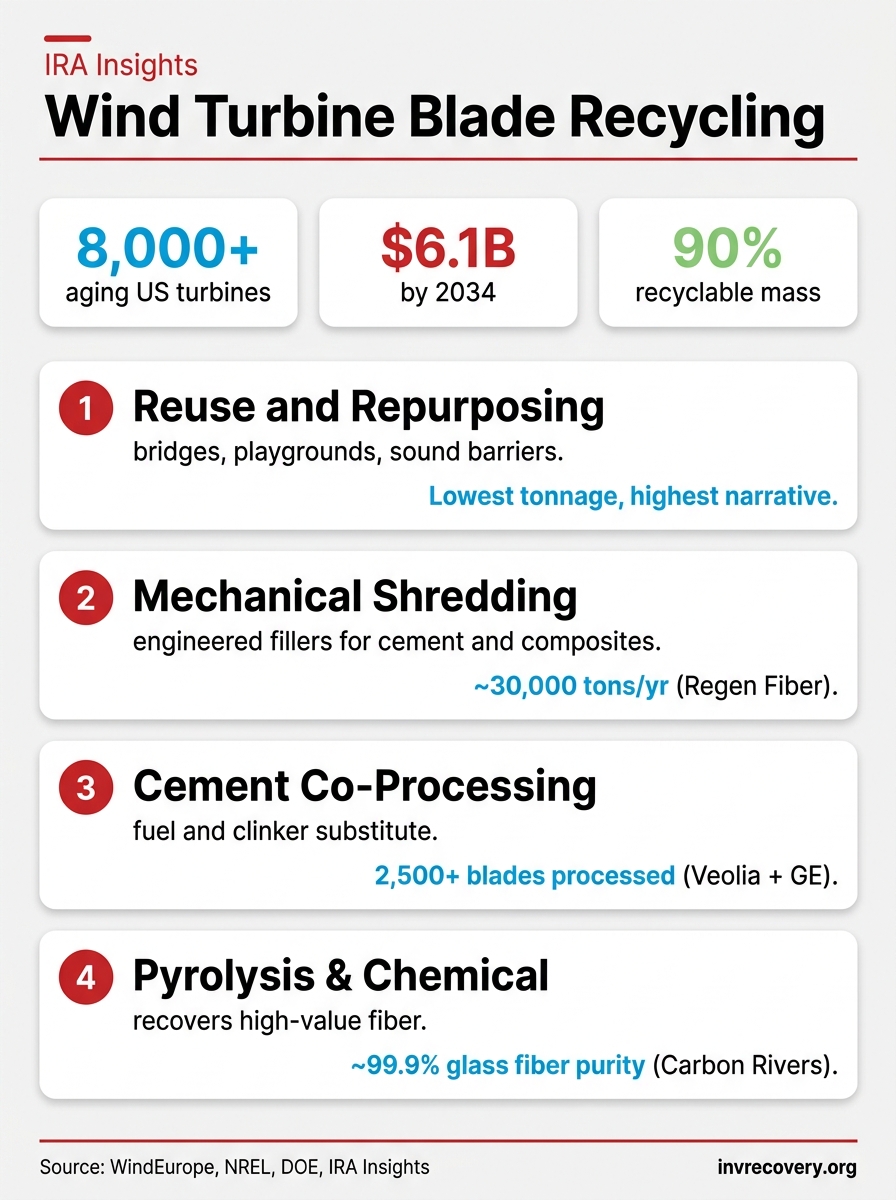
The four end-of-life pathways for wind turbine blade recycling, with the trade-offs investment recovery teams use to choose a vendor.
The Economics: Decommissioning Cost, Repowering Value, and Recoverable Revenue
The number IR leaders are asked first is the cost. Industry guides put per-turbine decommissioning between $100,000 and $300,000, and project filings (such as Palmer’s Creek Wind in Chippewa County, Minnesota) have run as high as $410,000 per turbine. Transparent Market Research projects the global wind turbine decommissioning market hitting $6.1 billion by 2034 at a 21% CAGR, with another forecast tracking 15.2% CAGR — a wide range that reflects how immature the cost-benchmarking work still is.
The number IR leaders are asked second is the revenue. Recoverable value generally falls into four buckets:
| Revenue Bucket | Source | IR Lever |
|---|---|---|
| Scrap metals | Tower steel, copper windings, aluminum, brass | Centralized scrap RFP, weight tickets, audit |
| Refurb / resale | Transformers, gearboxes, generators, controls | Tested-and-tagged remarketing channels |
| Repowering offset | Higher-capacity turbines on existing footprint | +62 MW avg uplift, fewer turbines per site |
| Composite credit | Recovered glass fiber, cement co-processing | Avoided tipping fees + circular content claims |
The repowering economics are especially powerful. USGS analysis of US land-based decommissioning shows repowered plants average −86 turbines and +62 MW per project, meaning the same site delivers significantly more energy with fewer modern, taller machines. For corporate buyers, repowering is also the cleanest way to deliver continuity of ESG-aligned power purchase agreements and tax credits without the permitting drag of a greenfield project.
Regulatory and Policy Pressure: The EU 2026 Landfill Ban Sets a Global Precedent
The EU’s January 2026 landfill ban is the headline, but the regulatory map is wider. Several US states already restrict the disposal of decommissioned wind components in conventional landfills, and the broader trend in zero waste to landfill technology is making “we sent it to the dump” an indefensible answer in a corporate audit. Three pressure points deserve specific attention:
Procurement disclosures. Corporate buyers of wind PPAs increasingly require end-of-life plans as part of their due diligence. Operators that cannot show a credible wind turbine blade disposal path lose deals.
Climate disclosures. Scope 3 reporting frameworks now ask explicitly for end-of-life emissions and avoided emissions from circular pathways. Sending blades to landfill is a measurable disclosure liability.
State permit conditions. Many state-level permits require financial assurance for decommissioning — surety bonds, escrow, or letters of credit — so the cost is already on the balance sheet whether or not anyone is optimizing it.
A useful comparison sits inside the IRA’s own archive: just as R2v3 and e-Stewards reshaped how ITAD vendors are audited, the wind industry is converging on certified, audit-ready blade recycling vendors that can provide chain-of-custody documentation. Corporate buyers should expect to see WindEurope’s circularity hub-style declarations, third-party audits, and downstream traceability as standard within 24 months.
How to Select a Wind Turbine Blade Recycling Vendor: An RFP Framework
Once a fleet reaches scale, the IR team’s job is to professionalize vendor selection. The RFP should treat recyclable wind turbine blades as one line in a larger end-of-life scope that also covers towers, nacelles, foundations, and transport. The framework below mirrors the structure already used for ITAD and surplus equipment:
1. Capability and capacity. Confirm annual processed tonnage, geographic footprint, and which pathway (mechanical, cement, pyrolysis, chemical) the vendor actually operates today. Beware vendors that pitch pyrolysis as commercial when their capacity is still pilot-scale.
2. Material accountability. Require weight tickets, downstream traceability to the cement kiln or fiber buyer, and reconciliation between mass in and mass recovered. This is the same audit trail IR teams are accustomed to in ITAD chain-of-custody documentation.
3. Certifications and compliance. Look for ISO 14001 environmental management, ISO 9001 quality, and any local regulatory permits required for thermal or chemical processing. Vendors operating in the US should be able to walk through state-level decommissioning rules without flinching.
4. Commercial structure. Some vendors charge a tipping fee, some pay a rebate based on recovered material value, and the difference can be six figures across a fleet. Spell out the fee waterfall in the RFP.
5. Insurance and indemnification. Decommissioning is a heavy industrial scope. Site liability, transport insurance, and downstream guarantees on landfill avoidance need to be explicit, not assumed.
6. ESG narrative. The vendor’s reporting tooling should plug directly into the buyer’s ESG and Scope 3 disclosures. If your sustainability team cannot use the vendor’s data, the deal will not survive the next audit.
Audit clause to include: “Vendor shall provide quarterly reconciliation of inbound blade tonnage, recovered material tonnage by category, and downstream destination of recovered material, with right of audit at vendor’s primary processing facility.”
A Six-Step Wind Asset Investment Recovery Roadmap
The pathway from “we have a fleet that is starting to age out” to “we have an audited recovery program” is shorter than most asset owners assume. The same six steps that anchor a strong investment recovery program startup apply almost line-for-line to wind asset retirement.
Step 1: Inventory and forecast. Build a fleet-level register of turbines by model, year of commissioning, capacity, location, and projected retirement date. Sequence the work over a 5-year horizon so contracts are not signed under crisis pressure.
Step 2: Component-level valuation. Apply current market values to recoverable steel, copper, transformers, gearboxes, and generators. Add a working assumption for blade composite credit (positive or negative) based on local pathway availability.
Step 3: Pathway map. For each retiring site, map the closest qualified recyclers across all four pathways. Distance to vendor frequently dominates the economics; a regional vendor with a $50/ton lower fee can be beaten by a more distant vendor with $80/ton transport savings.
Step 4: Vendor RFP and contract. Run the RFP framework above. Multi-year master agreements typically beat one-off project bids once a fleet exceeds 100 MW of pending retirements.
Step 5: Execution and chain-of-custody. Decommissioning is sequential — de-energize, dismantle nacelle, fell tower, foundation, blades. Each scope has its own contractor, and the IR team’s job is to make sure the recovery and recycling vendors are integrated into that schedule rather than bolted on at the end.
Step 6: Reporting and continuous improvement. Roll the results into the company’s circular economy and Scope 3 disclosures. Use the data to refine pathway assumptions for the next site. Over a five-site program, the IR team’s cost-per-MW retired should drop measurably as routing and vendor leverage improves.
Bottom line for IR leaders: Treat the wind fleet like every other portfolio of high-value retiring assets — with a register, a valuation model, a vendor scorecard, and a reporting loop. The composite blade is the hard part, but it is no longer the unsolved part.
Sources and References
- WindEurope, “Wind industry’s self-imposed landfill ban for decommissioned blades takes effect 1 January 2026” — windeurope.org
- WindEurope, “Where do wind turbine blades go when they are decommissioned?” — circularity pathways and EU industry positioning, windeurope.org
- U.S. Department of Energy, “Wind Energy End-of-Service Guide” — federal guidance on decommissioning, repowering, and recycling, energy.gov
- NREL, “Recycling Wind Energy Systems in the United States, Part 1” (2025) — capacity, retirement curves, blade volumes, nrel.gov
- USGS / Wiley Online Library, “Out with the Old: Empirical Trends in U.S. Land-Based Wind Turbine Decommissioning and Repowering” (2026) — repowering averages, MW uplift, onlinelibrary.wiley.com
- Transparent Market Research / GlobeNewswire, “Wind Turbine Decommissioning Market Size to Exceed US$ 6.1 Billion by 2034” (2025) — market sizing and CAGR, globenewswire.com
- Veolia North America, “Veolia Recognized for Being on the ‘Cutting Edge’ of Wind Turbine Blade Recycling” — cement co-processing case study, veolianorthamerica.com
- Carbon Rivers, “Glass Fiber Recycling” — pyrolysis process, fiber purity, US capacity, carbonrivers.com
- Vestas, “Blade Circularity” — CETEC chemical disassembly partnership with Stena Recycling and Olin, vestas.com
- Institute for Energy Research, “The Cost of Decommissioning Wind Turbines is Huge” — Palmer’s Creek Wind cost benchmark, instituteforenergyresearch.org
Frequently Asked Questions
Disclaimer: This article is published by the Investment Recovery Association (IRA) for educational and informational purposes only. It does not constitute legal, financial, or professional advice. Market data, statistics, and projections cited are sourced from third-party reports and are subject to change. Readers should consult qualified professionals before making business decisions based on the information presented. The IRA makes no warranties regarding the accuracy or completeness of third-party data referenced herein.